



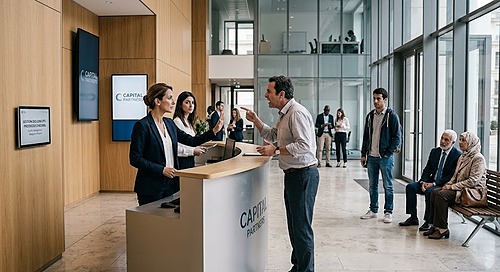
Maintaining the quality of service, whether face-to-face or on the phone, when a request becomes contentious.
Goals
- Identify the attitudes that fuel tension at reception.
- Adapt your words and posture to a variety of interlocutors.
- Defusing a complaint while preserving the image of the organization.
Program
Understanding the tensions
- Analyze one's reactions and the phases of a conflict; take into account the reception needs.
- Conducting a self-assessment of one's personality.
- Identify your own attitudes or (re)actions that generate conflict.
Prevent through dialogue
- To mobilize listening, questions and reformulation in order to re-establish a useful exchange.
- Put into practice the concepts of listening, questioning and reformulation (reminder).
- Discover and apply the Karpman triangle in conflict management.
Resolving a situation
- Choose a response appropriate to the conflicts, whether face-to-face or over the phone.
- Gaining an understanding of face-to-face conflict resolution methods.
- Forcing/domination, appeasement, disengagement, collaboration, compromise.
Regulating one's emotions
- Take a step back, respond to objections and assert yourself without overdoing it.
- Why take a step back in the context of a conflict?.
- Working on assertiveness and self-affirmation.
Practical application and feedback
- To work on a situation close to the participants' real-world experience.
- Compare several responses and observe their effects in an exchange or incident.
- Develop reflexes adapted to one's professional context.
Evaluation and validation methods
Prior self-assessment and assessment of acquired skills at the end of training.
Target audience
Reception staff and professionals in contact with the public
Prerequisites
Basic knowledge of in-person and telephone reception is recommended.