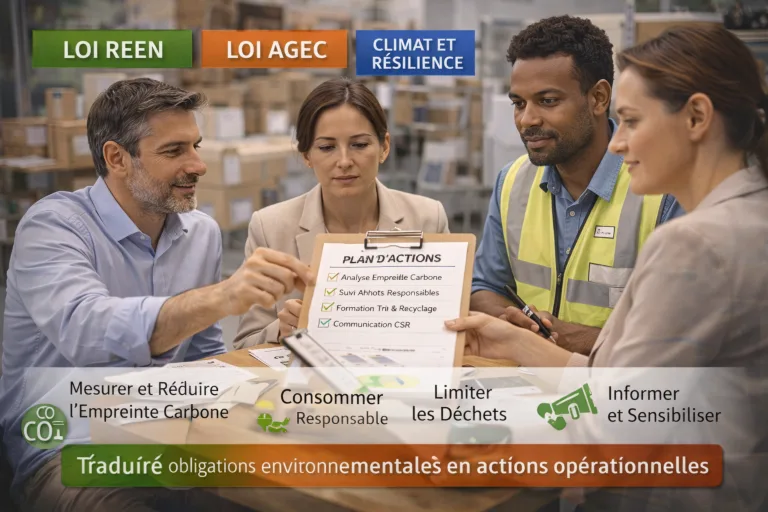



Soaring energy prices, coupled with climate imperatives, have brought the issue of energy efficiency in businesses back to the forefront. Commercial (offices, shops, service centers) and industrial buildings account for a significant portion of energy consumption: heating, air conditioning, lighting, ventilation, processes, and IT equipment. In this context, executives, technical departments, HR, and managers are looking for quick savings that don't necessarily require massive investments.

The first lever, often overlooked, is knowledge.
Many companies lack a detailed view of their energy consumption: they receive aggregate bills, sometimes with a few sub-meter readings, but little detail on the most energy-intensive areas. Installing meters or monitoring systems by zone, by use (heating, ventilation, processes), and by building makes it possible to identify anomalies: consumption at night or on weekends, unexplained spikes, and seasonal fluctuations. This initial, sometimes modest, effort can already reveal easy areas for improvement: switching off certain equipment outside of operating hours, optimizing system programming, and eliminating unnecessary standby lights.
Regarding heating and air conditioning
Stricter adjustments offer another avenue for rapid energy savings. Lowering office temperatures from 22°C to 19°C in winter, limiting air conditioning to reasonable levels in summer, and avoiding excessive temperature differences between indoors and outdoors can generate substantial savings without compromising comfort, provided these measures are implemented effectively. The key is clear communication, explaining the rationale, and involving employees in the process, rather than abruptly imposing guidelines that will be met with resistance. In workshops or production areas, localized solutions (workstation heaters, windbreaks, targeted insulation) can complement overall adjustments.
Lighting is another area
Switching to LED technology in areas still equipped with older lighting fixtures, installing motion detectors in hallways, restrooms, and certain storage areas, and segmenting circuits to avoid unnecessarily lighting large areas are all simple actions. They sometimes require an initial investment, but the return on investment is often rapid, given the savings generated.
In industrial buildings, optimizing auxiliary equipment (air compressors, ventilation systems, pumps) is a major challenge.
Compressed air leaks, for example, are a frequent source of energy waste. Implementing regular detection and repair campaigns, and raising awareness among teams about the importance of reporting abnormal noises, can significantly reduce losses. Similarly, adapting the operating hours of certain machines to actual needs, avoiding prolonged idle runs, and optimizing production plans contribute to greater energy efficiency.
The behavioral dimension plays a key role
A purely technical cost-saving policy, managed from a central department, risks missing opportunities. Involving employees in finding solutions—for example, through internal challenges, improvement groups, and rewarded suggestions—helps identify actions, habits, and practices specific to each site. An operator who suggests slightly modifying a cleaning procedure to reduce hot water and electricity consumption, or an employee who points out that an area is unnecessarily lit all the time, can lead to significant cumulative savings.
HR and managers have an important leadership role
They can integrate energy efficiency into internal communications, team meetings, and annual performance reviews. They can also ensure that these initiatives don't simply amount to a demand to "make an effort," without any compensation or recognition. Linking energy efficiency to the company's overall strategy, to reducing its vulnerability to cost increases, and to preserving jobs gives meaning to these changes.
To consider energy sobriety not as a one-off operation, but as a fundamental movement
Quick wins – adjustments, switching off standby modes, raising awareness – can be the first steps in a more structured approach, which will gradually include larger investments: thermal renovation, equipment upgrades, heat recovery, and the integration of renewable energy sources. The key is to build a roadmap, starting with low-cost, high-impact actions, and then planning the others over several years.