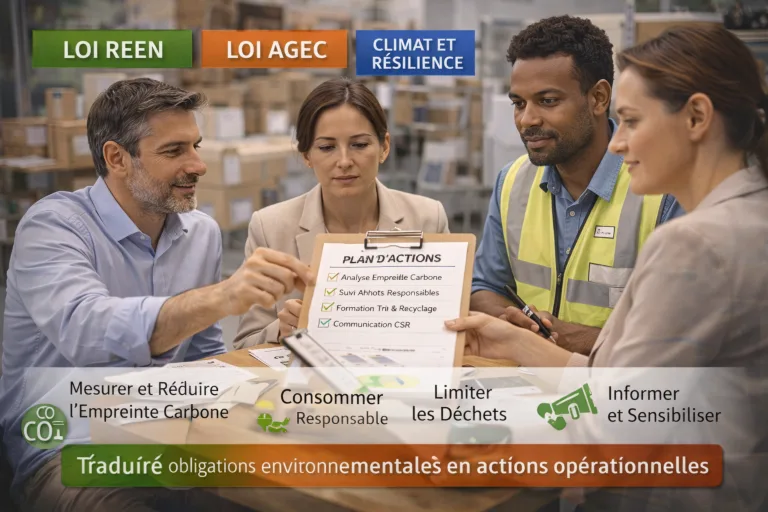



In many companies, HSE and CSR teams produce significant, sometimes impressive, results. Reduced accidents, lower energy consumption, improved working conditions, reduced waste, better management of chemical risks, and more structured subcontracting are just some of the achievements. And yet, these results often remain purely "technical," confined to internal dashboards. They don't become a cultural driver. They don't inspire. They don't transform the organization.
Highlighting positive impacts is not a marketing exercise. It is a tool for change. An organization changes faster when it sees that its efforts produce results, when it understands how those results were achieved, and when it can adopt concrete examples.
The first step is choosing what to measure. The trap is trying to measure everything and generating an avalanche of indicators. An effective narrative is built on a few "signature" results that resonate with the organization: fewer serious accidents, fewer long downtimes, more feedback from the field, a decrease in a major risk, a reduction in key consumption, a decrease in problematic waste, or an improvement in a highly perceived QWL (Quality of Work Life) irritant. These results must be understandable to everyone. And above all, they must be linked to what the teams actually accomplished.
The second step is to link the result to credible evidence. The company must be able to show the source of the figure, its scope, the time period covered, and the underlying assumptions. Here again, the HSE (Health, Safety, and Environment) discipline provides valuable training: traceability, consistency, comparability. Without proof, the valuation becomes a fragile communication strategy.
The third step is to tell a story, not a statistic. A statistic alone won't change behavior. A story will, because it gives meaning. A story about HSE-CSR impact often follows a simple structure: an initial situation (a real problem), a choice (a trade-off), an action (what was done), a result (what has improved), and a lesson learned (what is retained and what is deployed elsewhere). This narrative transforms a technical result into a replicable model. And that's what inspires action: the feeling that "it's possible" and "here's how.".
The fourth step is to make the impact tangible. The most powerful stories are those that come from the field: an operator explaining how a workstation was improved, a manager recounting how they handled a safety/deadline dilemma, a buyer explaining how they helped a supplier improve, a technician describing a maintenance improvement that reduced a risk. These testimonials create a mirror effect: they make the transformation relatable.
Finally, recognition must serve the next action. If the story is simply "well done," it provides fleeting pleasure. If it ends with "what we do now" (a rollout, a new routine, training, a standard), it generates momentum. Recognition then becomes a management tool: it reinforces what works and prepares for the next step.
Conclusion
Transforming technical results into stories isn't embellishment. It's a way to make the transformation contagious. We measure to guide, and we highlight to engage. When these two dimensions align, HSE and CSR cease to be support functions. They become cultural drivers.