


In international groups, a paradox is often observed: everyone uses the words HSE and CSR… but not everyone is talking about the same thing. The result: misunderstandings, frustrations, and sometimes global programs that fail because they are “logical” at headquarters, but not “credible” locally.
Understanding differences in perception is not an abstract cultural exercise. It is a prerequisite for operational success. Because an effective HSE/CSR policy depends less on slogans than on priorities, trade-offs, and how managers are engaged.
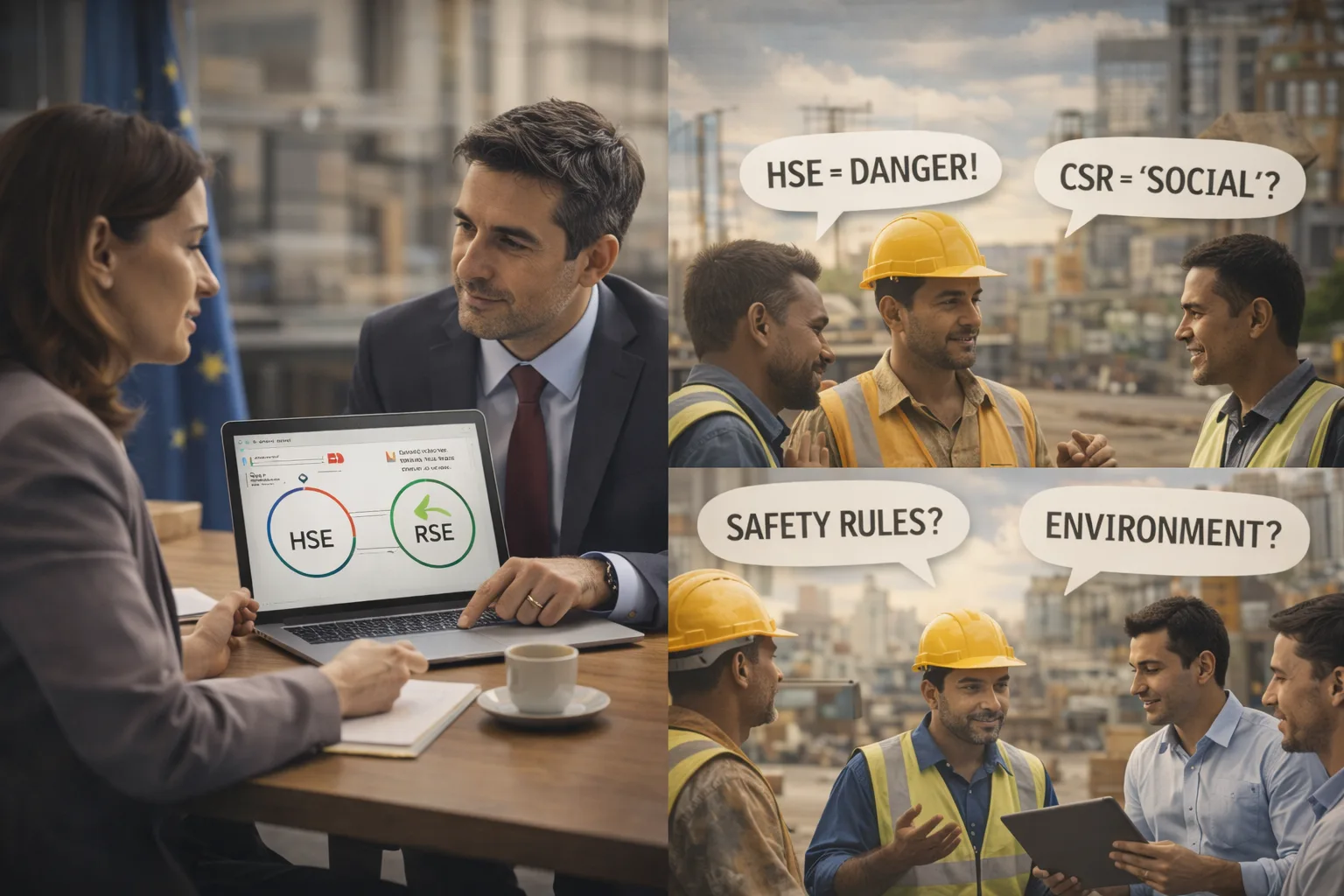
In France: HSE is highly regulated, CSR is very "societal"«
In France, the perception of health, safety, and environment (HSE) is heavily structured by the regulatory framework and social dialogue. Many companies have a strong compliance culture: risk assessment documents (DUERP), prevention measures, obligations, inspections, works councils (CSE), etc. Safety is often approached as a serious, regulated, and sometimes technical subject. The strength of this approach lies in its robustness: it is known how to formalize, track, and prove compliance.
CSR, on the other hand, is often perceived as broader and more "societal": inclusion, equality, ethics, climate, responsible purchasing, and local engagement. The risk in France, at times, is segmentation: HSE on one side (compliance and prevention), CSR on the other (reporting and engagement). When the two remain separate, a major lever is lost: the coherence between health and safety, working conditions, and environmental impacts.
In Europe: increased pressure on the value chain and data
In many European countries, the perception is more "systemic" across the value chain: suppliers, traceability, audits, customer requirements, ESG standards. Reporting and transparency issues more directly structure working methods, particularly in export-oriented industrial sectors.
The risk here is an excess of data: lots of reporting, lots of frameworks, but difficulty in translating that data into actionable decisions if managerial governance doesn't keep pace. The advantage, however, is integration: when the value chain is central, the company understands more quickly that CSR performance isn't solely a matter of internal operations.
In other regions: HSE stands for risk management, CSR for reputation or license to operate
In some parts of the world, the perception of HSE is more directly linked to risk management and business continuity. Safety is sometimes approached as a matter of protecting the business: reducing downtime, preventing major incidents, and preserving productivity. This is no less important; it's simply another entry point. It can lead to very effective HSE programs if leadership is strong, because managers see it as a key performance driver.
CSR, on the other hand, can be perceived as more "reputational" or linked to the "license to operate": relationships with communities, compliance with the requirements of international clients, controversy prevention, and investor expectations. Here too, the risk exists: if CSR is experienced as an external constraint rather than an internal transformation, it is reduced to mere communication or reporting.
The universal commonality: credibility is at stake in management.
Regardless of the region, one rule remains constant: employees and managers judge credibility based on what they see. And what they see are the decisions made. Do we stop when things are dangerous? Do we invest when a risk is identified? Do we adhere to the rules even when it's costly? Are the voices heard on the ground?
If you want a comprehensive policy that works, the right approach is "global on the non-negotiables, local on implementation." The non-negotiables define the backbone (vital rules, whistleblowing rights, ethical requirements, major incident management). Implementation is adapted to local realities (culture, maturity, regulations, resources, language).
Conclusion
Differences in HSE/CSR perception are not a problem to be corrected; they are realities to be integrated. A mature group does not seek to standardize messaging but rather to standardize the common ground and adapt implementation locally. This is how overall consistency is achieved… without disconnecting local teams.