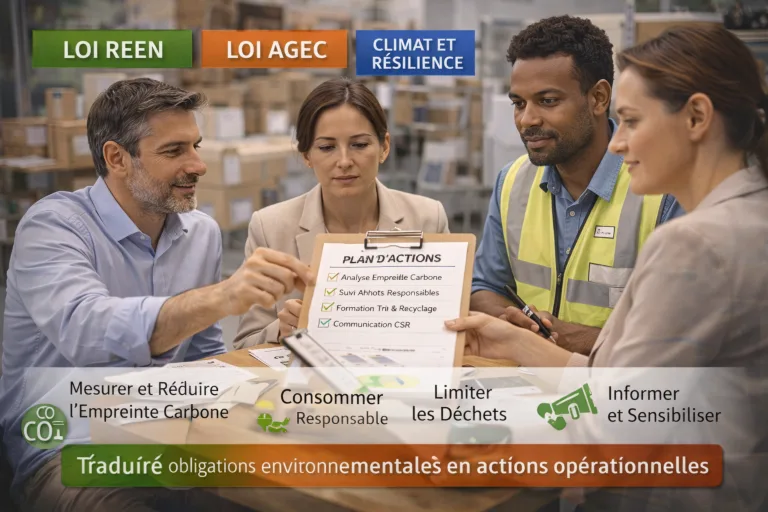



Climate change is often perceived as a complex scientific subject, reserved for specialists or environmental managers in large companies. Yet, its implications are now so profound that no executive, HR director, or manager can afford to ignore it. It already shapes, and will increasingly shape, markets, regulations, employee expectations, and operational risks. Understanding a few key concepts, without delving into all the technical details, is therefore essential for guiding strategic and managerial decisions.
Climate change results primarily from the increased concentration of greenhouse gases in the atmosphere, particularly carbon dioxide (CO₂), but also methane, nitrous oxide, and a few others. These gases trap some of the infrared radiation emitted by the Earth, leading to global warming. Since the Industrial Revolution, the burning of fossil fuels (coal, oil, and gas), deforestation, and certain agricultural practices have caused a rapid increase in these concentrations. Average global temperatures have already risen by approximately 1.1 to 1.3°C compared to the pre-industrial era.
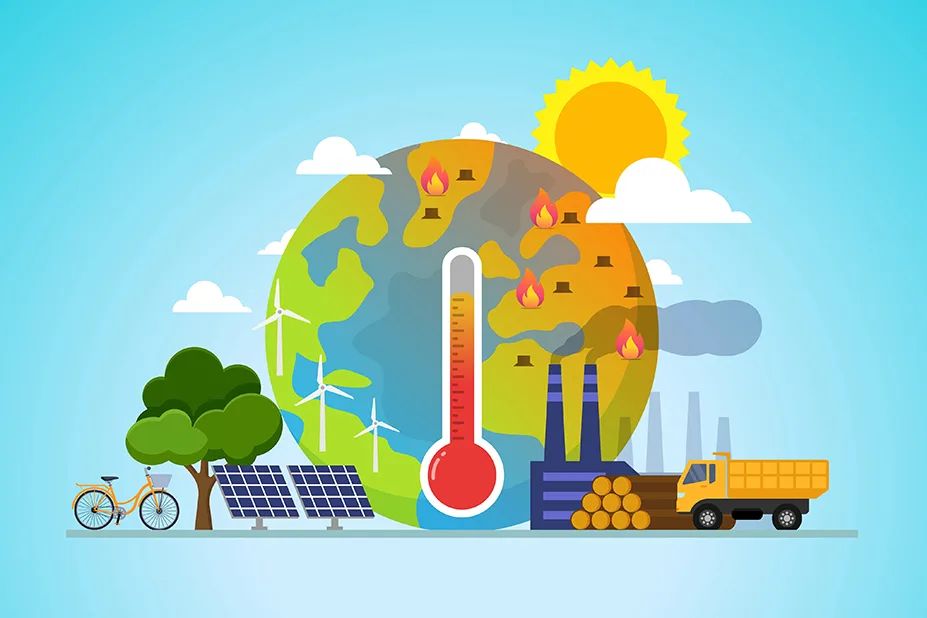
This average increase masks significant variations depending on the region, season, and extreme weather events. Specifically, climate change manifests itself through an increased frequency of heat waves, more intense droughts in some areas, more violent rainfall in others, rising sea levels, ocean acidification, and ecosystem disruptions. For businesses, these phenomena translate into multiple risks: unavailability of certain resources (water, raw materials), damage to infrastructure, disruption of supply chains, impacts on worker health (particularly in the event of extreme heat), and increased social tensions in certain regions.
International agreements, such as the Paris Agreement, aim to limit global warming to well below 2°C, and ideally to 1.5°C, compared to pre-industrial levels. To achieve this, it is necessary to drastically reduce greenhouse gas emissions worldwide by transforming our energy systems, modes of transport, industrial processes, agricultural practices, and consumption patterns. Governments are progressively adopting legislation to this effect; financial markets, consumers, and employees are demanding accountability from businesses. The climate transition is therefore not merely a matter of conviction, but a fundamental shift in the socio-economic landscape.
For a leader or manager, three questions arise: How does our company currently contribute to climate change? How will it be affected by the consequences? And how can it adapt and take action to reduce its footprint while ensuring its economic sustainability? The first question relates to emissions linked to the company's activities: energy consumption at its sites, business travel, production of goods or services, purchasing, logistics, and the use and end-of-life of products. These are what are known as "scopes" 1, 2, and 3 of greenhouse gas emissions.
The second question, that of impacts, invites us to consider physical climate risks: exposure of sites to flooding, fires, and heat waves; dependence on vulnerable resources (water, certain types of raw materials); and the fragility of certain infrastructures. It also invites us to consider so-called “transition” risks: regulatory changes (carbon tax, bans on certain products or processes), shifts in demand (customers turning to more sustainable offerings), and reputation (brand image associated with a sector perceived as polluting).
Finally, the third question opens up the levers for action. Reducing a company's carbon footprint is not simply a matter of offsetting emissions through external projects. It primarily involves energy efficiency (less consumption), improved efficiency (the same service with less energy or resources), the gradual replacement of fossil fuels with renewable or low-carbon energy sources, eco-design of products, the relocation or reorganization of certain value chains, and the promotion of lower-carbon transportation options. These transformations have direct consequences for work organization, skills, industrial strategy, and purchasing policy.
Human Resources plays a central role in this transition. They must anticipate the evolution of jobs, the need for new skills (energy efficiency, life cycle analysis, new processes, maintenance of low-carbon technologies), and the social impacts of certain decisions (site closures, restructuring of production lines, job transformations). They are also on the front line in supporting employees to understand these issues, ensuring that climate change is not perceived as a distant topic, disconnected from their daily lives, but rather as a structuring element of the company's project.
Simply understanding climate change, for a leader or manager, means being willing to look beyond the immediate horizon. It means integrating the likely consequences of tomorrow, in terms of both risks and opportunities, into today's decisions. It also means recognizing that a company's credibility, with both its customers and employees, depends on the consistency between its words and actions on this issue. Without becoming a climatologist, every stakeholder in governance can grasp these basic concepts to better guide their strategy in a world in transition.