


In many companies, the BDESE (Economic, Social and Environmental Database) is perceived as a digital filing system intended to "hold" records for works council consultations. However, the legislator's intention is more ambitious: the BDESE is meant to gather the information necessary for recurring consultations and now also incorporate the environmental consequences of the company's activities. It is mandatory for companies with 50 or more employees.
The problem is that the environment is often treated as a secondary issue: a few figures, sometimes consolidated at the group level, that are difficult to link to operational decisions. And that's exactly how social dialogue breaks down: we talk about the environment in theory... while those on the ground and managers are dealing with very concrete trade-offs (energy, waste, investments, subcontracting, processes).
The necessary shift lies in considering the environmental component as a shared management tool, not as a reporting tool. The decree that specified the indicators established a simple logic: it is not about a narrative, but about concrete elements of environmental policy and a few key areas (circular economy, resources, climate).

What the environment section actually says (and how to make it “readable”)
The “supplementary” content (when there is no agreement) notably includes:
- General policy : organization, environmental assessment/certification processes.
- Circular economy : hazardous waste (traceability), water consumption, energy consumption.
- Climate change : identification of direct emission sources (Scope 1) and, for the companies concerned, GHG assessment.
The value, for both the Works Council and managers, isn't simply seeing "numbers." It's understanding: what's changing, why, and what decisions were made behind it. For example, an increase in energy consumption could stem from a surge in workload (good business news), a process deviation (a problem), a change in scope (an explanation), or a colder winter (context). Presenting figures without a narrative of the decision-making process inevitably creates suspicion or unproductive debate.
The decree also includes a common-sense point that is too often overlooked: when data is produced at another level (group, establishments, etc.), it must be put into perspective at the company level. In other words: no "group copy-paste" without local translation.
The real challenge for 2026: linking environment, work and decisions
If you want the environmental aspect to become a tool for social dialogue, you need to link it to two things: real work and investment decisions.
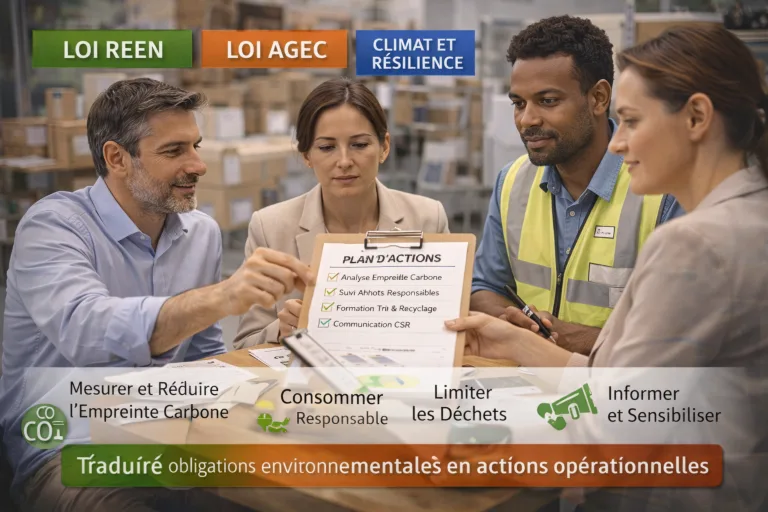
In terms of actual work practices, environmental issues almost always translate into organizational changes: sorting and waste flow, product changes (solvents, lubricants, cleaners), storage constraints, procedures, subcontracting, maintenance, and purchasing. Therefore, if the Works Council (CSE) identifies an energy/waste trajectory, it must be able to link it to concrete actions (process modifications, optimization, new equipment) and to the impacts on working conditions (workload, new procedures, associated risks). This is where Health, Safety, and Environment (HSE) and Human Resources (HR) play a key role: anticipating the effects and preventing the transition from creating safety issues or hidden hardships.
In terms of decision-making, the BDESE (Environmental and Social Data Base) becomes truly useful when it informs CAPEX/OPEX trade-offs: which investments reduce energy consumption, which projects reduce hazardous waste, which actions have a return on investment (ROI), which are mandatory, and which are part of a customer strategy. A BDESE that doesn't connect the environment to "how we decide" will remain just a document. A BDESE that shows "here are our significant items, here are our actions, here are our results, here are our upcoming decisions" becomes a tool for transformation.
Moving from an annual document to a dialogue-based approach
The best management hack is to move away from the reflex of a massive annual update. The BDESE (Economic, Social and Environmental Database) serves as a basis for consultations, but there's nothing wrong with a more dynamic pace: a quarterly update on 3-4 key indicators (energy, water, hazardous waste, direct emissions), and a review of the associated decisions. This reduces tension because the Works Council no longer feels like it's discovering figures all at once without context. And it helps managers because the company becomes more disciplined in explaining its strategies.
Conclusion
The BDESE (Economic, Social and Environmental Data Base) is mandatory for companies with 50 or more employees, but its value depends entirely on how it's used. If you treat the environmental aspect as a reporting matter, you'll have endless debates. If you treat it as a decision-making tool (and a common language between management, HR/HSE, and employee representatives), you gain a rare advantage: social dialogue that truly accelerates transformation.