


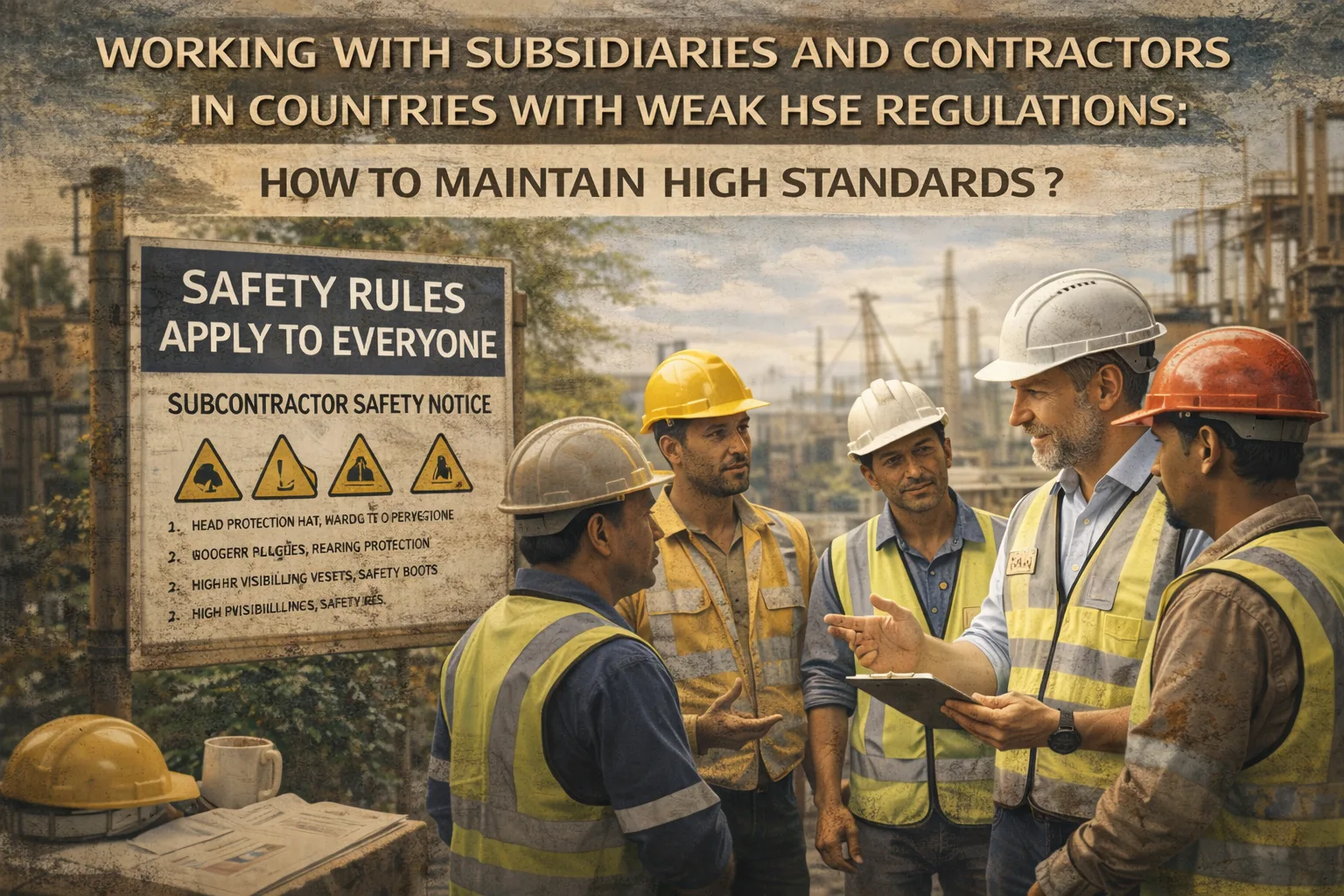
When a company operates in countries where HSE regulations are less stringent – or less enforced – it faces a dangerous temptation: lowering standards in the name of "local realism." In the short term, this may seem pragmatic. In the long term, it is a major risk: serious accidents, reputational damage, customer churn, internal tensions, and even legal liability, depending on the circumstances.
The question is therefore not "can we maintain a high level of requirements?" The question is "how to do it intelligently, without imposing a disconnected model?".
Let's start with a simple truth: your responsibility doesn't end with the contract.
Even if a service provider is legally "independent," the human and reputational impact of an accident or social misconduct reflects back on the client. And beyond image, there's a reality: a fragile value chain jeopardizes business continuity. Therefore, HSE requirements are a tool for building resilience.
The right strategy: match the requirement to the risk, and mitigate major risks.
In these situations, two symmetrical errors must be avoided. The first is demanding "everything, right now": this leads to fictitious documents and concealment. The second is demanding nothing: this leads to tragedy.
The most robust strategy is to first identify the major risks and establish non-negotiable requirements on these points. Typically: energy and lockout/tagout, working at height, equipment and traffic, confined spaces, fire, chemicals, machinery, and critical work permits. On these subjects, the client must set clear standards, audit the actual situation, and be able to suspend activity if the risk is too high.
For the rest, we are building a realistic, step-by-step progress plan. The goal is to increase maturity, not to achieve instant compliance.
The operational key: contract + verification + support
In a country with weak regulations, a contract is necessary but insufficient. It sets the rules, but it doesn't create the capacity. Verification is therefore essential: site visits, short audits focused on major risks, observation of practices, verification of qualifications, and comprehension tests. And support is often the deciding factor: joint training, sharing of simple tools, feedback from experience, and technical assistance on critical investments (machine protection, ventilation, fire safety).
The most demanding company is not the one that imposes the most sanctions. It is the one that makes demanding standards feasible, while remaining firm on the protection of life.
Don't forget the human element: culture, language, power, and the cascading subcontracting.
In certain contexts, hierarchy, fear of job loss, or a culture of "don't contradict" can prevent alerts from being raised. If you apply a "Western" standard based on transparency without addressing this factor, you are creating a superficial prevention strategy. Therefore, the channels must be adapted: trusted local contacts, the possibility of anonymous reporting, simple rituals, and managers trained to listen.
And we need to address the cascading subcontracting: many problems originate at the second or third tier, invisible in the contracts. High standards require a minimum level of transparency regarding who does what, and with what level of oversight.
Conclusion
Maintaining a high level of HSE in countries with weak regulations is not a matter of abstract morality. It is a strategy for protecting life, ensuring robustness, and building credibility. This is achieved by combining three things: non-negotiable commitments on major risks, on-the-ground verification focused on reality, and support that builds evidence rather than paperwork.