


1. Introduction: A cross-cutting and ever-relevant risk
Falls from height remain the the leading cause of serious and fatal accidents at work In France, representing nearly 20% of fatal accidents according to INRS (2023). In the construction industry, they particularly concern work on scaffolding, but industry and maintenance are not spared (technical shutdowns, interventions on machines, facade work or in workshops).
A poorly erected, unchecked, or improperly used scaffold can turn an ordinary construction site into a disaster. These accidents not only have tragic human consequences, but also... legal and economic consequences important for the company: production stoppages, criminal penalties, recognition of inexcusable fault, damage to image.
In France, fall prevention falls under the purview of both the Labor Code, of the French and European technical standards, and of the case law, which regularly reminds employers of their obligations.
2. The regulatory framework: Labor Code and employer obligations
The Labor Code requires the employer to general security obligation (Art. L. 4121-1 to L. 4121-5):
«"The employer takes the necessary measures to ensure the safety and protect the physical and mental health of workers..."»
When applied to scaffolding, this translates into specific requirements:
- Article R. 4323-69 "The assembly, dismantling or modification of scaffolding is carried out under the direction of a competent person and by workers who have received adequate and specific training."«
- Article R. 4323-72 : obligation to check the scaffolding before first use, after any modification or event likely to have affected it (falling object, bad weather).
- Article R. 4323-77 : obligation to keep a verification log.
- Article R. 4141-13 : obligation of practical safety training for workers exposed to particular risks (including working at height).
Construction and Public Works Context : A Specific health and safety plan (PPSPS) must incorporate measures specific to scaffolding. Industry/Maintenance Context : in the event of co-activity, a prevention plan (art. R. 4512-6 et seq.) must be established between the user company and the external company.
3. Applicable French and European standards
The standards complement the Labour Code by specifying the technical requirements.
Table of correspondence between requirements and practical actions
| Reference | Object | Key requirements | Practical actions |
|---|---|---|---|
| NF EN 12810 / 12811 | Façade scaffolding (components and performance requirements) | Mechanical resistance, stability, flooring, guardrails | Check conformity with manufacturer's specifications; receive the scaffolding before use. |
| NF EN 1004-1 (2021) | Rolling scaffolds | Maximum height, floor width, wind stability, integrated access devices | Check wheel locks, do not use in strong winds, follow manufacturer's instructions |
| NF P 93-520 | Assembly, disassembly, transformation (MDS) | Mandatory training for installers, adherence to operating procedures | Verify the authorization of MDS employees, monitor operating procedures |
| NF EN 363 / 365 | Fall arrest systems (fall protection PPE) | Harnesses, lanyards, energy absorbers, compliant anchors | Annual periodic inspection of PPE, practical training in its use |
| Order of 21/12/2004 | Periodic general checks | Pre-commissioning checks every 3 months, recorded in the register | Establish a written procedure for periodic verification |
👉 Translation for the employer : ensure the Regulatory compliance + standards compliance = enhanced security obligation.
Step-by-step methodology for fall risk assessment
Step 1: Analyze the task
- What is the working height ?
- What is the exposure time ?
- What are the environmental conditions (wind, loose soil, rain)?
- Is there a co-activity with other trades?
Step 2: Identify the danger zones
- Unprotected floor edges.
- Hoppers, openings, passageways.
- Access to the scaffolding (stairs, ladders).
Step 3: Assess the risk (rating grid)
| Criteria | Rating (1 to 5) | Example |
|---|---|---|
| Gravity | 1 = benign, 5 = fatal | A fall of 6 m = gravity 5 |
| Probability | 1 = rare, 5 = frequent | Assembly/disassembly = probability 4 |
| Mastery | 1 = complete mastery, 5 = not mastered | No guardrail = mastery level 5 |
Overall score = Severity × Probability × Control
👉 Risk > 50 = unacceptable, requires work to stop until it is corrected.
Step 4: Choose the access method: Decision tree
- Duration < 1 hour : PIRL or gondola.
- Duration > 1 hour, height < 2.5 m : rolling scaffold conforming to NF EN 1004-1.
- Duration > 1 hour, height > 2.5 m : scaffolding with feet (NF EN 12810/12811).
- Work in complex access : multidirectional scaffolding or lifeline with PPE.
Step 5: Define prevention measures
- Prioritize collective protections (floors, guardrails, nets) over PPE.
- Verify the competence of the fitters (MDS training).
- Record the checks in the log.
5. Practical tools for prevention specialists
«"The assembly, dismantling and modification of scaffolding must be carried out under the supervision of a competent person by..." workers specifically trained in the assembly, dismantling and modification of scaffolding » (mandatory training, with certificate).
Reference to articles R.4323-69 to R.4323-80 of the Labour Code + decree of 21 December 2004.

5.1 Scaffolding Reception Checklist
- Compliance with the assembly plan
- Stability on solid supports
- Anchors present and correct
- Continuous, flawless floors
- Guardrails and baseboards in place
- Secure access
- Absence of deformed elements
- Compliant signage
- Post-weather inspection
- Record in register
5.2 Daily verification checklist (10 points)
- Wheel lock (rolling scaffolds)
- Floors in good condition
- Guardrails not moved
- No overload
- No objects stored at height
- No unauthorized modifications
- Signage always visible
- Suitable weather conditions
- Clear access
- Visual inspection of anchors
5.3 Recording in the security register
- Date and time of verification
- Identity of the verifier
- Observations and anomalies
- Corrective measures taken
- Responsible signature
6. Recent and significant case law
Case 1: Cass. crim., October 15, 2019, No. 18-83.980
An employee fell 4 meters from a mobile scaffolding platform without guardrails. The employer was found liable for involuntary injury and failure to comply with safety obligations.
Case 2: Lyon Court of Appeal, March 12, 2020, No. 18/04567
Accident during maintenance of an industrial boiler. The scaffolding had not been inspected or recorded in the logbook. The user company was held civilly liable.
Case 3: Cass. crim., March 23, 2021, no. 20-82.642
A scaffold erector fell to his death during dismantling work without proper safety training. The company was convicted of manslaughter.
Case 4: TGI Marseille, April 5, 2022, no. 20/01245
Gross negligence was found due to the failure to conduct periodic inspections of the facade scaffolding. The ruling includes an increased work-related accident annuity and damages.
7. From prevention to education: diagrams and infographics
For a junior audience, visual learning is essential. Infographics can represent:
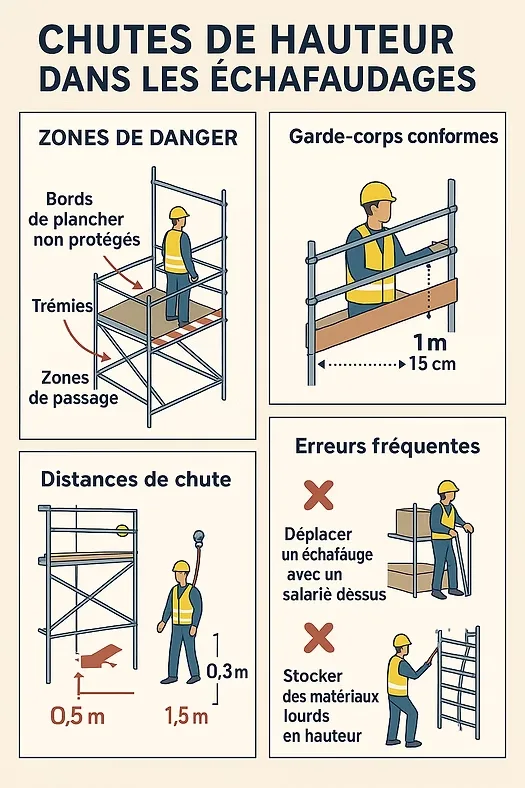
- Danger zones on scaffolding (edges, hoppers, passage areas).
- Compliant guardrails (height 1 m, plinth 15 cm, intermediate rail).
- Fall distances and fall factor with PPE.
- Do / Don't :
- Do ✅: lock the wheels, check floors, use built-in access.
- Don't ❌: moving scaffolding with an employee on it, storing heavy materials at height, making makeshift access.
8. Conclusion: Safety at height, a shared responsibility
Preventing falls from height on scaffolding involves three key issues:
- Human : to protect the life and health of workers.
- Economic : reduce stoppages, compensation, production losses.
- Legal : avoid criminal convictions and inexcusable negligence.
Risk assessment must be integrated into DUERP and updated regularly. For the employer, acting quickly and effectively means not only meeting a legal obligation, but also strengthening the company's social performance.
Evaluating, preventing and securing scaffolding means investing in the sustainability of the organization and in the confidence of employees.