



Key figures for training funding
In 2024, France dedicated 56.6 billion euros to continuing vocational training and apprenticeships. The top three funding bodies are:
- companies : €16.4 billion, or 29 % of total expenditure (up 1.9 % compared to 2023)
- OPCOs (skills operators): €12.4 billion, or 22 % of the total
- the State : 8.7 billion euros, or 15.3 % (excluding public employees).
Source: Budgetary document annexed to the 2026 draft finance law.
How does the training money circulate?
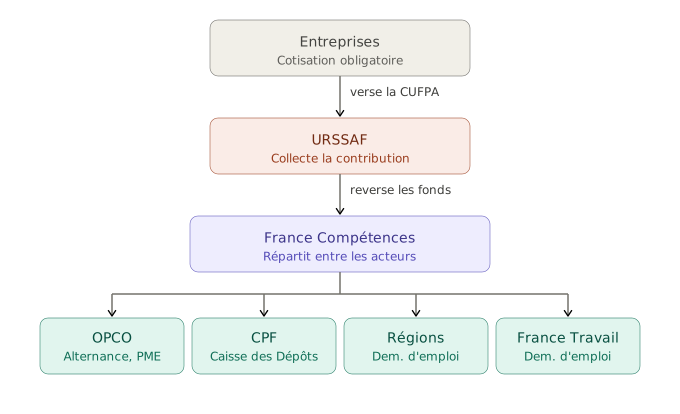
The funding process now follows a well-defined path:
- Employers pay each month, via the DSN (Social Security Declaration), the single contribution for vocational training and apprenticeships (CUFPA) to the’URSSAF. They also directly finance the training of their employees.
- The URSSAF transfer these mandatory contributions to France Compétences, the national regulatory body.
- France Compétences then distributes the funds among the OPCO (skills development plan for very small and small businesses, apprenticeships), the Caisse des dépôts et consignations (CPF manager) and France Work (training for job seekers).
Business contributions
The single contribution (CUFPA)
Effective since 1er As of January 2019, the CUFPA (Contribution to Vocational Training and Apprenticeship) combines the vocational training contribution and the apprenticeship tax. It is declared monthly via the DSN (Nominative Social Declaration), like social security contributions. Its rate depends on the number of employees:
- fewer than 11 employees : 1.23 % of the payroll (0.55 % training contribution + 0.68 % apprenticeship tax)
- 11 employees or more : 1.68 % (1 % training contribution + 0.68 % apprenticeship tax).
The conventional contribution
Some professional sectors have entered into training agreements requiring additional payments to the OPCO (Skills Operator), beyond the legal minimum. Contact your local OPCO for more information.
Voluntary contribution
Any company can make voluntary payments to its OPCO, without legal or contractual obligation, to finance specific actions and access enhanced services.
Overview of available resources
OPCO funding
OPCOs primarily finance skills development plans for companies with fewer than 50 employees, apprenticeship contracts and collective actions at negotiated rates. Discover OPCO funding.
The FNE-Formation
The government, through the FNE-Formation program, supported training programs related to major transitions (ecological, digital, food, demographic). This program was not renewed for 2025-2026. Learn more about the FNE-Formation program.
The ESF+ 2025
The European Social Fund finances, via certain OPCOs, up to 50% of training costs for in-demand jobs, transitions and transversal skills. Learn more about the ESF+ 2025.
The CPF
The Personal Training Account allows each working person to finance certified or qualifying training throughout their career, including in co-construction with the employer. Learn more about the CPF.
Career changes
The retraining period (since the 1er January 2026) and the Professional Transition Project make it possible to finance a career change. Learn more about retraining funding.
Job seekers
France Travail supports job seekers with Individual Training Assistance (AIF), Operational Preparation for Employment (POE, individual or group), and the Personal Training Account (CPF), which may be supplemented. The first step: validate your project with your France Travail advisor.
Regions and Europe
Regional councils co-finance training for job seekers, young people entering the workforce, and some employees undergoing career transitions. The European Social Fund (ESF+, 2021-2027 programming period) supports public and private projects promoting employment, skills development, and inclusion.
MDConseil Formation supports you
Identifying the right scheme, checking the eligibility of your project, putting together the funding application: our teams guide you at every step to optimize the financing of your training.