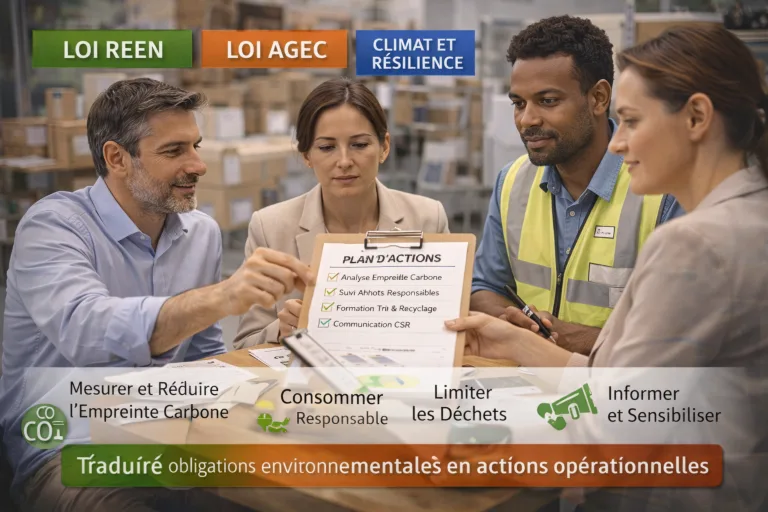



Many companies believe that a structured CSR department is necessary to implement responsible purchasing. This is incorrect. What is needed is a simple method and minimal governance. Responsible purchasing is not about "buying green"; it's about integrating HSE, environmental, and social criteria into the purchasing decision in a way that is proportionate to the risk.
The first step isn't to write a charter. It's to understand where the impacts lie. In virtually every organization, 80% of the risk is concentrated in a few key areas: energy, transportation, waste, raw materials, chemicals, high-risk services (maintenance, construction, cleaning), IT, and equipment. From there, the idea isn't to address everything at once, but to choose three priority areas—those where gains can be achieved quickly and risks reduced.

Next, responsible purchasing needs to be made workable for procurement teams. The best approach is to establish a three-tiered "rule of the game." For simple, low-risk purchases, basic requirements are applied (compliance, traceability, eco-friendly practices, standard clauses). For significant purchases, criteria and evidence are added (certifications, energy performance, substances, origin, working conditions, prevention plan). For high-risk purchases (construction, chemicals, critical subcontracting), a more rigorous process is formalized: audit, HSE validation, prevention plan, and potentially a committee decision.
What causes many initiatives to fail is overcomplicating things. The best tool, at the outset, is often a one-page document: "what we require," "what we verify," "when we reject." Buyers need clear boundaries. And so do operational staff: if the rule isn't simple, it will be circumvented under time pressure.
The third point is contractualization. Responsible procurement cannot succeed without clauses. Not decorative clauses, but enforceable ones: compliance obligations, access to evidence, the right to a reasonable audit, the requirement for an improvement plan, and the handling of non-conformities. And above all: a monitoring mechanism. Without follow-up, the clause becomes a forgotten PDF. With follow-up, it becomes a lever for transformation.
Finally, the relationship between purchasing, HSE, and operations needs to be organized. Many conflicts stem from a poor division of roles: purchasing thinks in terms of "cost/delivery time," HSE thinks in terms of "risk," and operations think in terms of "will it work or not?" The solution isn't a battle, but a ritual: a monthly or bimonthly review of critical purchases, where decisions are made transparently.