



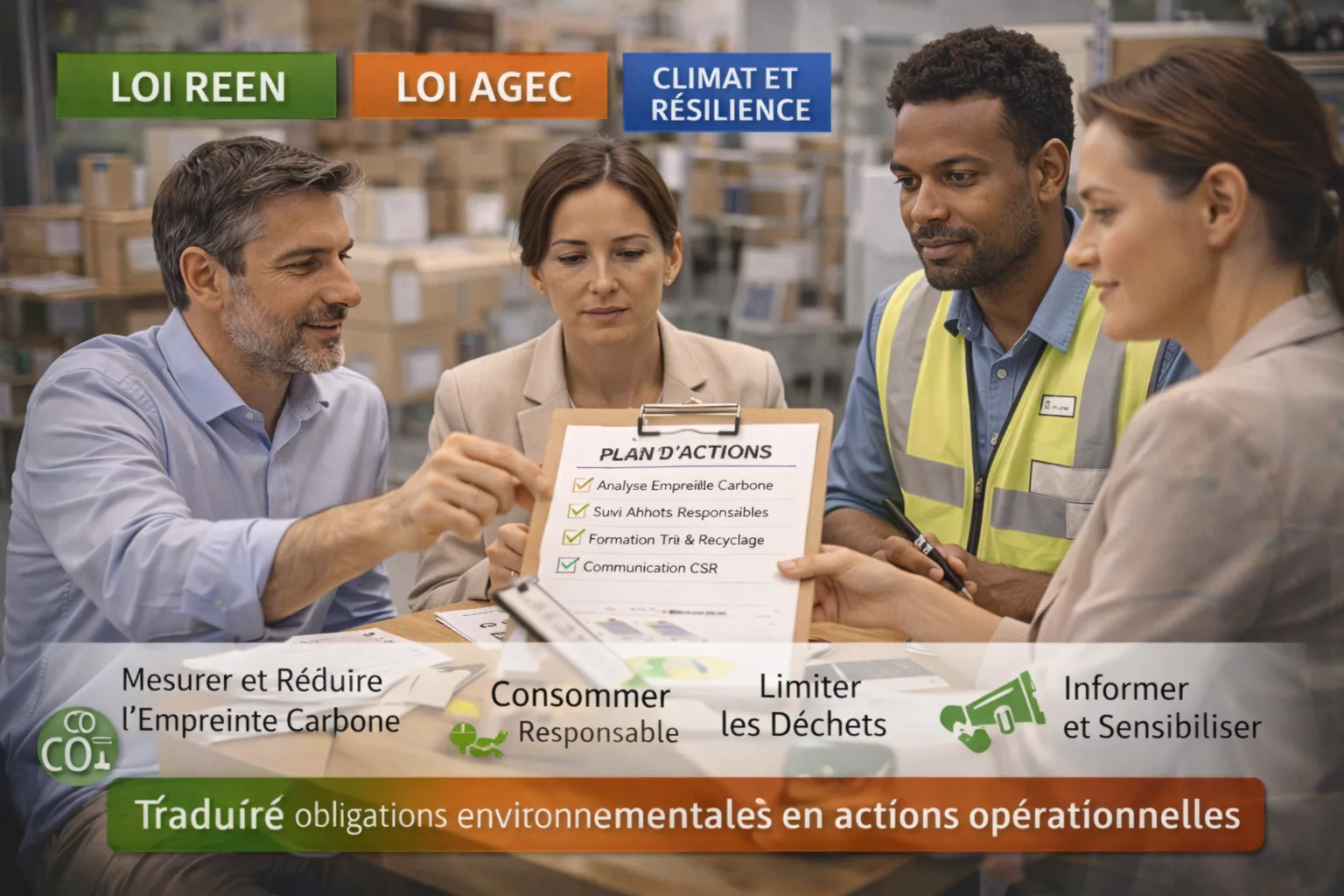
Many companies experience environmental laws as an added burden: one more constraint, one more line in an action plan. In reality, these texts (REEN for digital technology, AGEC for the circular economy, Climate & Resilience for accelerating the transition) share a very useful commonality: they push organizations to transform "CSR" issues into concrete processes, controllable and auditable. In other words: less slogans, more mechanics.
The REEN law (reducing the environmental footprint of digital technology) reminds us of an often ignored fact: the majority of the impact of digital technology comes from the manufacturing equipment and accelerated renewal.
The operational logic is therefore primarily an asset management logic: buy less, keep longer, repair more, and design more sustainable digital services.
In companies, this translates into very concrete decisions: a life cycle policy (minimum duration per type of equipment), purchasing criteria favoring repairability and refurbishment, renewal rules actually applied (not "by feel"), and management of usage (storage, video, attachments, printing).
The AGEC law (anti-waste for a circular economy) and its implementing texts encourage a shift from "we sort" to "we rethink the flows".
The operational approach is always the same: map waste and products, secure supply chains, reduce at the source, and integrate circularity into purchasing and design.
In practical terms, for a company, AGEC should not be limited to putting more sorting bins.
We must also address the "invisible" issues: packaging (reduction, reuse), managing unsold goods when we are involved, product information when we put products on the market, and the robustness of evidence (supply chain contracts, slips, traceability).
Finally, the Climate & Resilience Law is a "Swiss Army knife" of legislation: mobility, advertising, consumption, governance, public procurement, etc. For businesses, two aspects are particularly practical. First, the issue of environmental claims : the law regulates messages of the type "carbon neutral" by imposing conditions of transparency (emissions balance integrating direct/indirect emissions, reduction approach, etc.).
Next, a set of measures related to the transformation of practices (mobility, LEZ depending on the territories, sectoral trajectories, etc.), with an increase in requirements on the public procurement side from August 21, 2026, which directly impacts suppliers and subcontractors who respond to markets.
To avoid fragmentation, there's a simple method for "translating the law into action." First, identify the functions truly affected by each piece of legislation: REEN covers IT, purchasing, digital marketing/communications, and data; AGEC covers production, purchasing, logistics, quality, maintenance, and sometimes sales; and Climate & Resilience covers marketing (claims), mobility, purchasing, and governance. Then, formalize three things: non-negotiable decisions (e.g., IT renewal policy, packaging requirements, communication rules), evidence indicators (e.g., refurbishment rate, average lifespan, recovery rate, traceability), and a managerial review schedule.
The good news is that this "translation" is rarely a net cost. In many companies, it quickly generates gains: fewer purchases of digital equipment, less waste, less packaging waste, and less risk of non-compliance and negative publicity surrounding claims. Compliance then becomes a bonus: the real value lies in operational robustness.