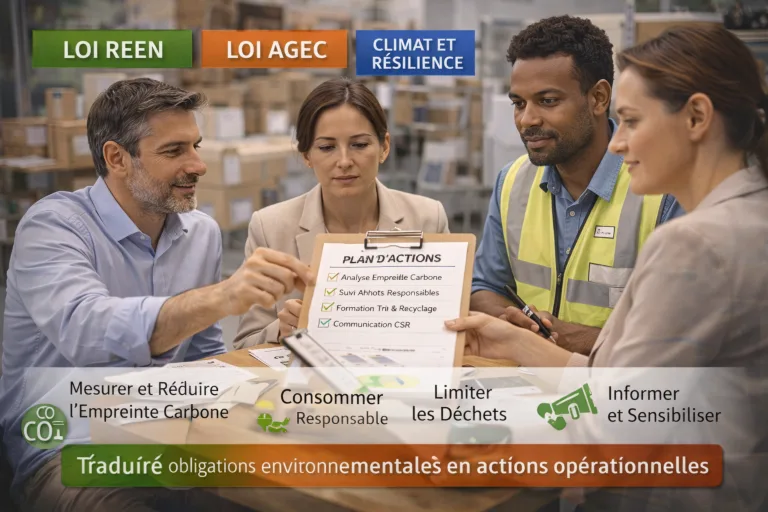



Many companies want to get employees involved in CSR. They launch challenges, themed days, and suggestion boxes. Sometimes it works. Often, it fizzles out. The difference between a lasting commitment and a one-off event lies in one thing: the link between participation and the power to act. If employees have ideas but no resources, or if ideas are shared but never implemented, engagement quickly turns into cynicism.
The first condition for success is therefore clarity: what exactly do we want to involve employees in? Too many initiatives fail because they try to cover everything. Employees are more likely to engage when they are offered a concrete and relevant scope: reducing waste, improving recycling, limiting unnecessary consumption, ensuring safe co-activity, reducing workplace stressors, improving a workstation, or simplifying a process. When the issue is relevant to daily life, it becomes legitimate.
The second condition is the credibility of the process. Many suggestion boxes are graveyards of good intentions. For it to work, a highly visible processing mechanism is essential: a deadline, a selection review, simple criteria (impact, feasibility, cost, timeframe, safety), a response to each proposal, and above all, a public commitment to implementing a certain number of ideas. The important thing is not to retain all the ideas. The important thing is to prove that the system is working.
In this context, a workshop is often more effective than a challenge. A well-designed workshop brings together people experiencing the problem, support staff who can help, and a manager who can mediate. Participants work within a time limit, choose one or two realistic actions, and decide who does what. The key is to produce a visible result quickly. Speed is a form of respect: it shows that the company takes the effort seriously.
Challenges, however, work when they are well-structured and avoid assigning blame. A "paperless" or "turn off the lights" challenge can be perceived as patronizing if, at the same time, the organization is wasting resources on a large scale. Employees notice the inconsistencies. An effective challenge focuses on actions that teams can actually manage and is accompanied by addressing structural issues. Otherwise, people are being asked to compensate for the system's flaws.

Calls for ideas can be very powerful, provided they are linked to a budget and dedicated time, however modest. A "small projects" fund with a fast approval process is often a huge accelerator. It transforms CSR into action and makes management more credible because they can say yes.
Conclusion
Involving employees in CSR isn't about organizing more activities. It's about creating a system where ideas become actions, where actions become results, and where results are recognized. Sustainable commitment is a product of execution.