


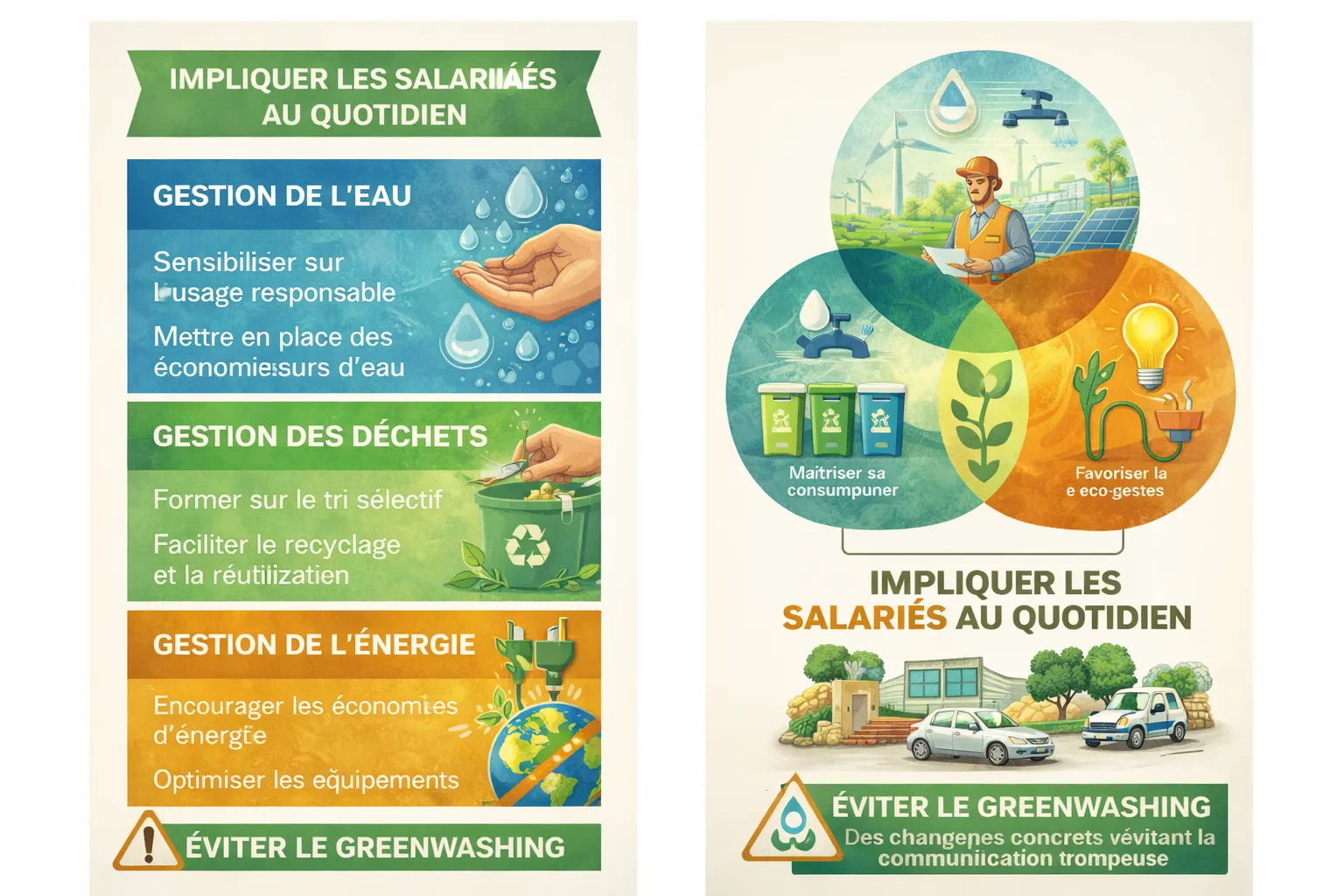
More and more companies are looking to mobilize their employees around everyday actions related to water, waste, and energy. "Turn off the lights when you leave" posters, recycling awareness campaigns, internal challenges to reduce paper consumption, one-off events for World Environment Day… These initiatives are well-intentioned, but they can be perceived as greenwashing if they are not part of a broader, coherent strategy, also supported by structural decisions at the management level.
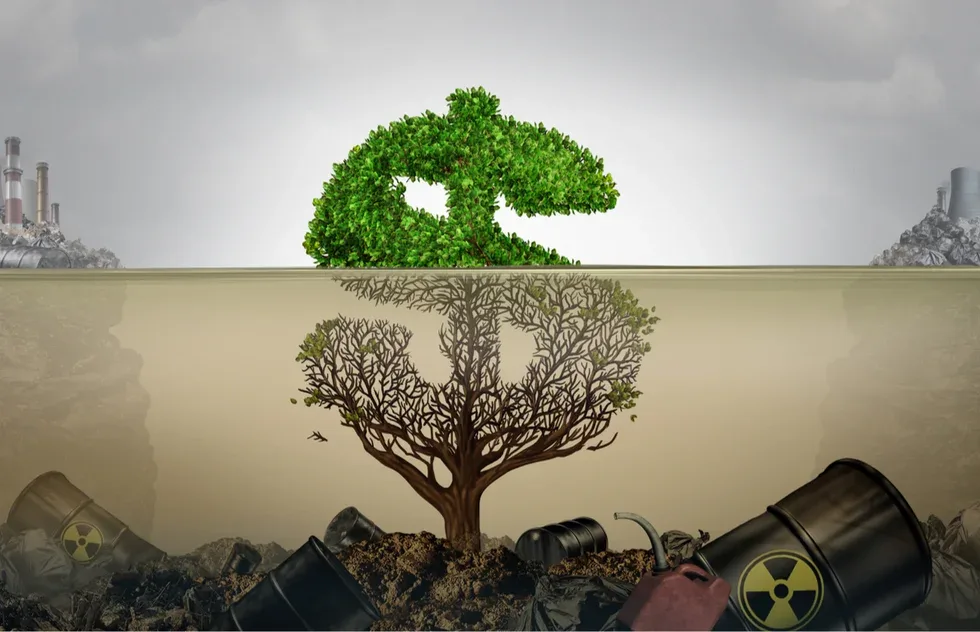
For genuinely involve employees, It is essential to address these issues on two levels: that of individual actions and that of organizational choices.
Asking employees to be careful with tap water, while allowing leaks to continue for weeks, creates a dissonance.
Encouraging waste sorting, but not providing suitable bins, or then mixing the collected waste streams, undermines the credibility of the approach.
Calling for reduced energy consumption while maintaining poorly insulated buildings, obsolete equipment, or superfluous lighting fuels skepticism.
The starting point, therefore, is to clarify the company's resource commitments.
What objectives has it set for itself in terms of reducing water consumption, reducing and recovering waste, and improving energy efficiency?
What specific projects are planned – building renovations, equipment upgrades, changing waste service providers, installing recovery systems?
Communicating about these elements, explaining the constraints, the room for maneuver, the investment choices, shows that we are not simply asking employees to "do their part": the organization is also taking its responsibilities.
Pedagogy is essential. Rather than simply using slogans, it is useful to explain the concrete impact of certain actions: how many liters of water saved by detecting and quickly repairing a leak, how much CO₂ avoided by reducing this or that consumption, what cost to the company represents for the disposal of poorly sorted waste.
When presented simply and illustrated, these figures allow employees to understand that their actions have a real effect, even if it is modest on an individual level.
Active team participation is another powerful lever. Rather than deciding from above on the actions to be taken, it is possible to organize workshops, improvement groups, and participatory audits on certain sites.
Employees can then suggest ideas for reducing consumption, better organizing sorting, and simplifying instructions.
Many pragmatic solutions emerge from this collective intelligence: repositioning of bins, adjusting cleaning schedules, eliminating superfluous consumables, modifying routine practices.
HR and managers have a key role in anchoring these approaches. They can integrate these topics into team discussions, interviews, and new employee onboarding programs.
They must also remain vigilant about fairness: avoiding a situation where certain categories of staff are the only ones called upon (“operational staff must make an effort”) while others are exempt.
A credible approach involves everyone, from the field to headquarters, including support functions and management.
Finally, Authenticity is the best antidote to greenwashing. Recognizing that the company is not perfect, that it still has progress to make, that it cannot transform everything overnight, but that it is embarking on a trajectory, inspires more confidence than triumphalist speeches disconnected from experience.
Regularly sharing progress reports – what has been successful, what has been more difficult, what has been postponed – shows that these issues are being taken seriously.
Valuing grassroots initiatives and publicly thanking those who get involved reinforces the feeling that everyone's participation counts.
Involving employees in the management of water, waste and energy is therefore not a communication operation.
It is a fundamental task, requiring consistency, transparency, and listening.
When carried out with sincerity, it can become a powerful driver of mobilization, pride, and concrete transformation of daily practices.