



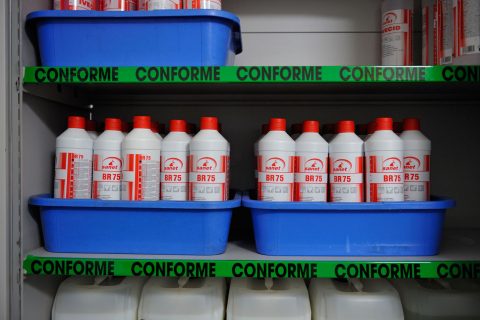
This refresher course aims to maintain and update the skills of individuals exposed to chemical risks. It reactivates essential skills for reading CLP labels and safety data sheets, reinforces best practices for storing, transferring, and managing waste, and strengthens fire prevention, ATEX, and transport (ADR) protocols. It draws on participants' experience to address the most common shortcomings.
Goals
Upon completion of the training, the participant will be able to:
- Identify the hazards of a chemical product from the CLP labeling (pictograms, signal words, H and P statements) and key sections of the safety data sheet (SDS).
- Identify entry routes and work situations that generate exposure, including to CMR agents.
- Apply the rules for storage, transfer and waste management, and correct the most frequent deviations (incompatibilities, unidentified containers, lack of containment).
- Implement fire prevention and ATEX reflexes as well as the basics of transport regulations (ADR).
- Choose appropriate prevention measures and collective and individual protective equipment (CPE/PPE) based on the SDS and the work situation.
Program
- The five key questions to ask before using any product.
- Danger, exposure and routes of entry; key points on CMR agents.
- CLP labelling: pictograms, hazard statements, H and P statements.
- SDS: key sections to be reactivated (2, 4, 5, 6, 7, 8, 10, 13 and 14).
- Incompatibilities to remember (acids/bases, bleach/acids, flammable/oxidizing, products reacting with water, new products/contaminated waste).
- STOP transfer method: Secure, Trace, Organize, Protect; prohibited practices.
- Retention, separation, essential signage and hazardous waste disposal channels.
- Fire triangle and formation of an explosive atmosphere (ATEX); prevention reflexes.
- Hierarchy of measures: suppression, substitution, collective protection, organization, PPE.
- Selection of PPE and EPC based on the SDS and the work situation.
- ADR basics: UN number, hazard class, official designation, transport documents.
- Final practical synthesis case study (identification of hazards, measures, PPE, storage/waste, ADR).
- Final multiple-choice quiz of 20 questions (passing grade 16/20) and answer key with commentary.
Evaluation and validation methods
Exercises that can be done remotely: guided discussions, group work, case studies, multiple-choice questions and annotated corrections.
Target audience
All personnel who have already undergone awareness training or chemical risk training and who are required to handle, store, transfer or dispose of chemical products: operators, maintenance agents, warehouse workers, logistics agents, line management.
Prerequisites
Prior training or awareness-raising on chemical risks, or practical experience handling chemicals, is required. No specific educational level is necessary. Fluency in written and spoken French is required to follow the course content and complete the multiple-choice questionnaire.