



The Skills Development Plan (SDP)
Since January 2019, the Skills Development Plan has replaced the Training Plan. It encompasses all the actions implemented by an employer for its employees to ensure their adaptation to the job or their continued employment.
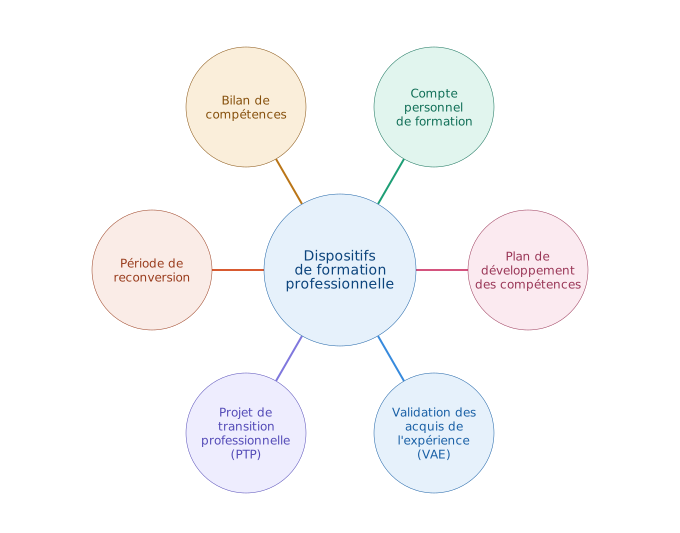
The PDC incorporates a wide range of modalities: face-to-face training, distance learning, blended learning, work-based training actions (AFEST), skills assessments and VAE.
The employer has three legal obligations: to ensure employees are properly trained for their positions, to maintain their employability, and to provide safety training. Beyond these obligations, the employer can also fund training programs aimed at improving company performance or supporting individual employee projects.
The Personal Training Account (CPF)
The CPF (Personal Training Account) allows every working individual to accrue training entitlements that can be used throughout their professional life. Funded in euros since 2019, the account is credited with:
- €500 per year, within the limits of 5 000 € for most employees
- €800 per year, within the limits of 8 000 € for the less qualified (level below CAP).
Only the training courses qualifying or certifying Eligible qualifications include: diplomas, professional certifications, CQP (Professional Qualification Certificate), VAE (Validation of Acquired Experience), skills assessments, and driver's licenses. Everything is managed on [website/platform name]. MyTrainingAccount (website or mobile application).
As part of the CPF co-constructed, The company can contribute to the employee's account to finance training that is useful to both parties — a win-win approach integrated into HR policy.
Work-study training programs
The apprenticeship contract
- Audience : young people aged 16 to 29 (up to 30 years old for people with disabilities)
- Targeted qualifications From vocational certificates to Master's degrees (engineering degrees, etc.)
- Remuneration : 65% of the minimum wage for those under 18, 80% for those between 18 and 20, 100% for those 21 and over
- Duration : 1 to 3 years depending on the diploma
The professional training contract
- Audience young people aged 16 to 29 or job seekers aged 30 and over
- Targeted qualifications : CAP to Bac +2 (or professional qualification in the sector)
- Remuneration : identical to age-appropriate learning
- Duration : 6 to 12 months (up to 24 months with industry agreement)
In both cases, hiring incentives are available — inquire with your OPCO or the Ministry of Labour.
Professional retraining programs
The retraining period (since January 1, 2026)
Established by the law of October 27, 2025, the retraining period replaces the Transco and Pro-A schemes. It allows an employee to change jobs, either internally (remaining within the company) or externally (fixed-term retraining contract with suspension of the original contract). Skills development organizations (OPCOs) provide the funding. Learn more about career change.
Operational Preparation for Employment (POE)
The POE promotes the integration of job seekers by enabling them to acquire the skills necessary to hold a specific job.
- Individual POE (POEI) : initiated by a company that is recruiting, jointly funded by France Travail and the employer
- POE collective (POEC) : for a group of job seekers in in-demand professions, managed by the sector and financed by the OPCO.
The Professional Transition Project (PTP)
The PTP, successor to the Individual Training Leave since 2019, allows employees to train for a new profession while maintaining their salary. Main conditions:
- Permanent contract (or fixed-term contract of at least 12 months within the last 18 months)
- 1 year of seniority in the company (6 months for VAE or in-demand professions)
- Employer's agreement
The cases are handled by the associations Transitions Pro from each region.
AFEST — Work-Based Learning
Recognized by the 2018 Professional Future Act, AFEST (Action de Formation en Situation de Travail - Workplace Learning Action) is a structured learning pathway that takes place directly in the employee's workplace. It alternates between practical work situations and reflective sessions led by a trainer or tutor. AFEST is eligible for OPCO funding.
VAE — Validation of Acquired Experience
The VAE (Validation of Acquired Experience) allows for the official recognition of skills acquired on the job, without going through traditional training. It is accessible to anyone who has carried out a professional activity (employee, self-employed, volunteer) related to the diploma sought during at least one year.
The process takes place in three stages:
- File composition describing the main activities, their context and the skills used
- Assessment of the file by a jury
- Interview to present and defend the skills acquired.
The jury may decide on full validation, partial validation, or rejection. In the case of partial validation, further training is possible. VAE (Validation of Acquired Experience) is eligible for funding through the CPF (Personal Training Account) or the skills development plan.