


1. Why talk about psychosocial risks today?
Employee well-being is a major issue for modern companies, both to meet legal obligations and to attract and retain talent. Psychosocial risks remain a serious concern: chronic stress, isolation, mental overload, internal conflicts, and a loss of meaning can severely affect employee health and organizational performance.
From a human perspective, these risks lead to burnout, absenteeism, and anxiety disorders. From an organizational perspective, they cause increased turnover, social conflicts, and decreased motivation. The indirect costs (lost productivity, disorganization) impact competitiveness.
In France, occupational risk assessment is a legal obligation. The Labor Code requires employers to take the necessary measures to ensure the safety and protect the health of workers, in particular by:
- risk prevention
- information and training
- the establishment of an appropriate organization and resources
This approach must be included in the Single Document for the Assessment of Occupational Risks (DUERP), which is updated regularly. Since 2022, this document must serve as the basis for a multi-year prevention action plan.
Assessing psychosocial risks is therefore not optional: it is both a legal obligation and an opportunity to positively transform the organization.
2. Understanding the reference models: Karasek and Siegrist
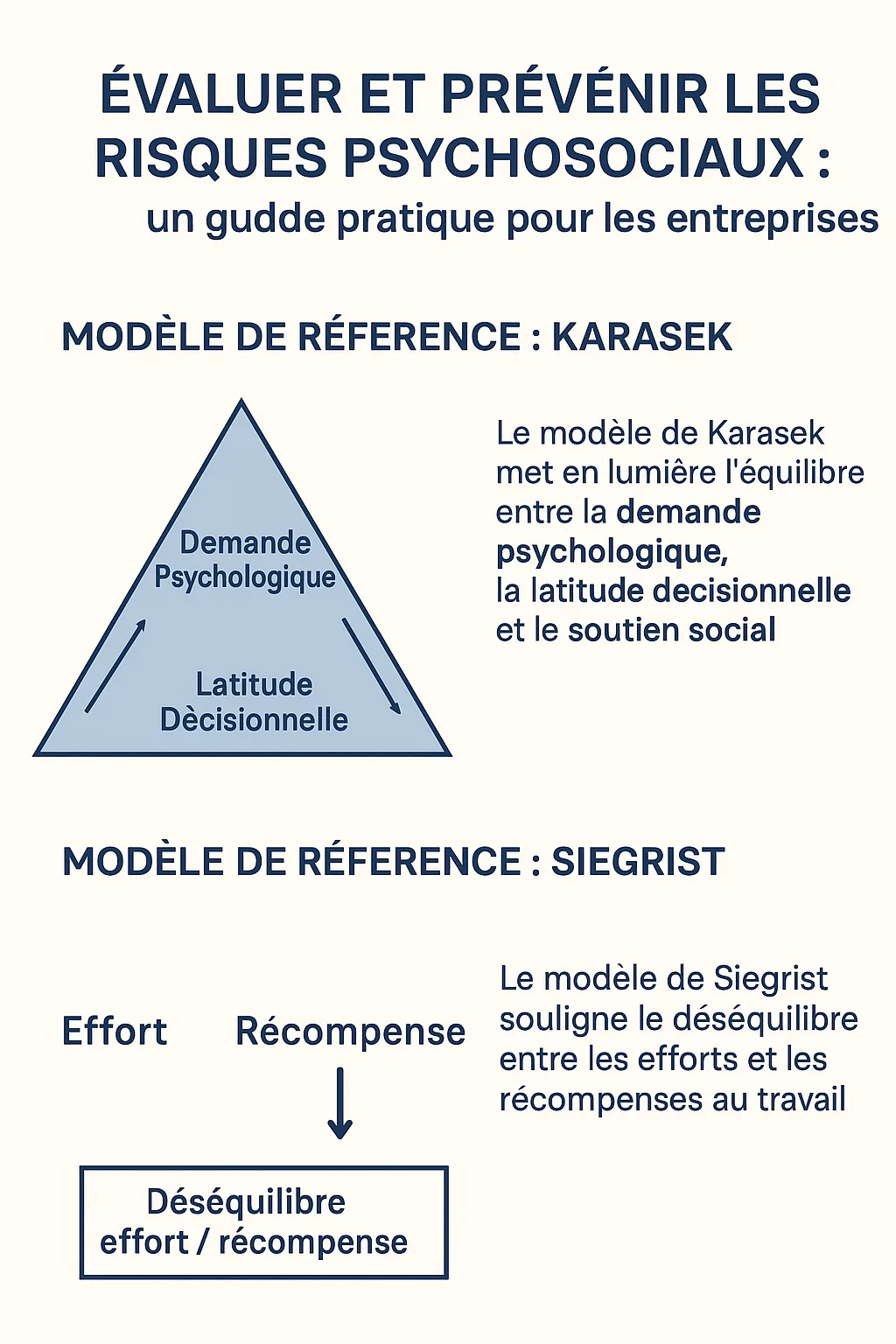
To understand psychosocial risks, several scientific models are used in practice. Two of them stand out for their robustness and accessibility: the Karasek model and the Siegrist model.
Karasek's model: the balance between demand, autonomy and support
The model developed in the 1970s, called Job Demand-Control-Support model, emphasizes three key elements:
- The psychological demand : workload, time pressure, task complexity.
- Decision-making latitude : autonomy, ability to organize one's work, use of one's skills.
- Social support : quality of relationships with colleagues and superiors.
According to this approach, jobs present a particular risk when demand is high while autonomy and support remain low. This "Karasek triangle" helps to identify contexts that generate prolonged stress.
Siegrist's model: effort and reward
THE effort-reward model (1996) is based on a fundamental principle: when there is an imbalance between the efforts invested by the employee and the benefits received (remuneration, recognition, opportunities for advancement), this creates tension that is detrimental to health. acknowledgement constitutes a determining factor in this equation.
Why are these models useful to businesses?
These questionnaires function as powerful diagnostic tools, allowing us to:
- To provide an objective basis for employees' perceptions
- Detecting warning signs
- Enrich the risk assessment document
- Guiding mitigation strategies
3. Methodology for assessing psychosocial risks in the company
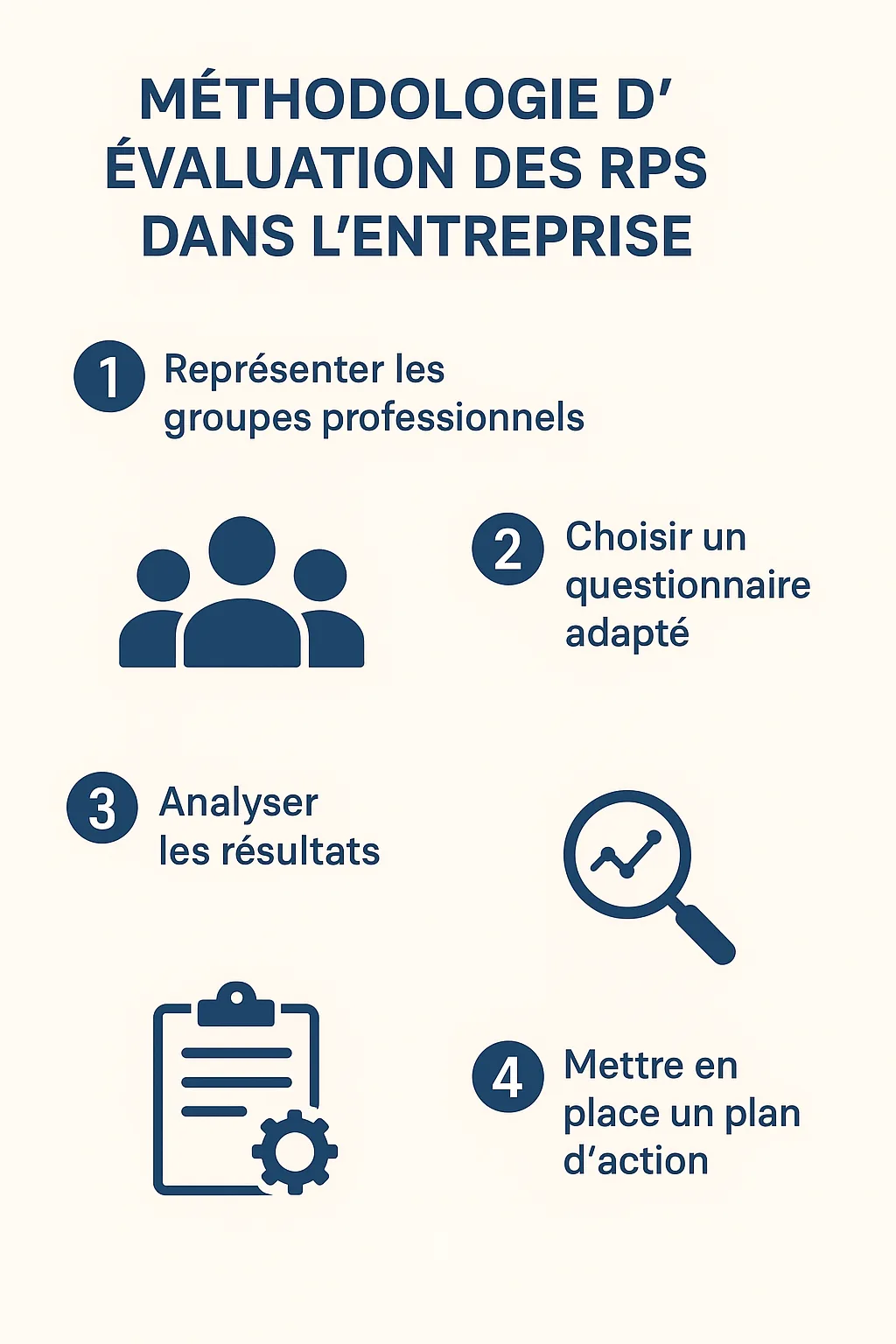
Implementing a psychosocial risk assessment process requires combining methodology, active listening, and collective commitment. Here are the main recommended steps:
Step 1: Form a project team
Management involvement is essential, but it is also necessary to involve employee representatives, the HR department, the occupational health physician, and, if possible, frontline employees. This approach guarantees the legitimacy of the process.
Step 2: Identify the risk factors
Several tools can be used:
- Standardized questionnaires (Karasek, Siegrist, COPSOQ, INRS RPS-DU)
- Individual and group interviews to gather perceptions
- Indicator analysis (absenteeism, turnover, accidents, sick leave)
Key recommendation: use external specialist resources to ensure neutrality and compliance with the GDPR.
Step 3: Analyze the results and prioritize the risks
The data is put into perspective with the organization of work to prioritize risks according to their severity and frequency.
Step 4: Integrate into the DUERP and define an action plan
The identified risks are recorded in the DUERP, then translated into organizational, managerial or collective actions, with the creation of working groups involving volunteer staff.
Case study: a struggling SME in the service sector
Diagnosis identified:
- High psychological demands related to tight deadlines
- low decision latitude
- Limited social support due to a very top-down management style
Increased absenteeism and staff turnover reaching 25 %.
Action plan implemented:
- Restructuring into autonomous teams to better distribute the workload
- Training middle managers in active listening
- Creating convivial moments to strengthen bonds
Result : 15% reduction in absenteeism over twelve months, increased employee satisfaction.
4. From prevention to quality of working life (QWL/QWLCT)
Assessing psychosocial risks should not be limited to preventing harmful situations. It is also an opportunity to promote quality of life and working conditions (QWL), which is now integrated into social dialogue in France.
QVCT: a positive approach
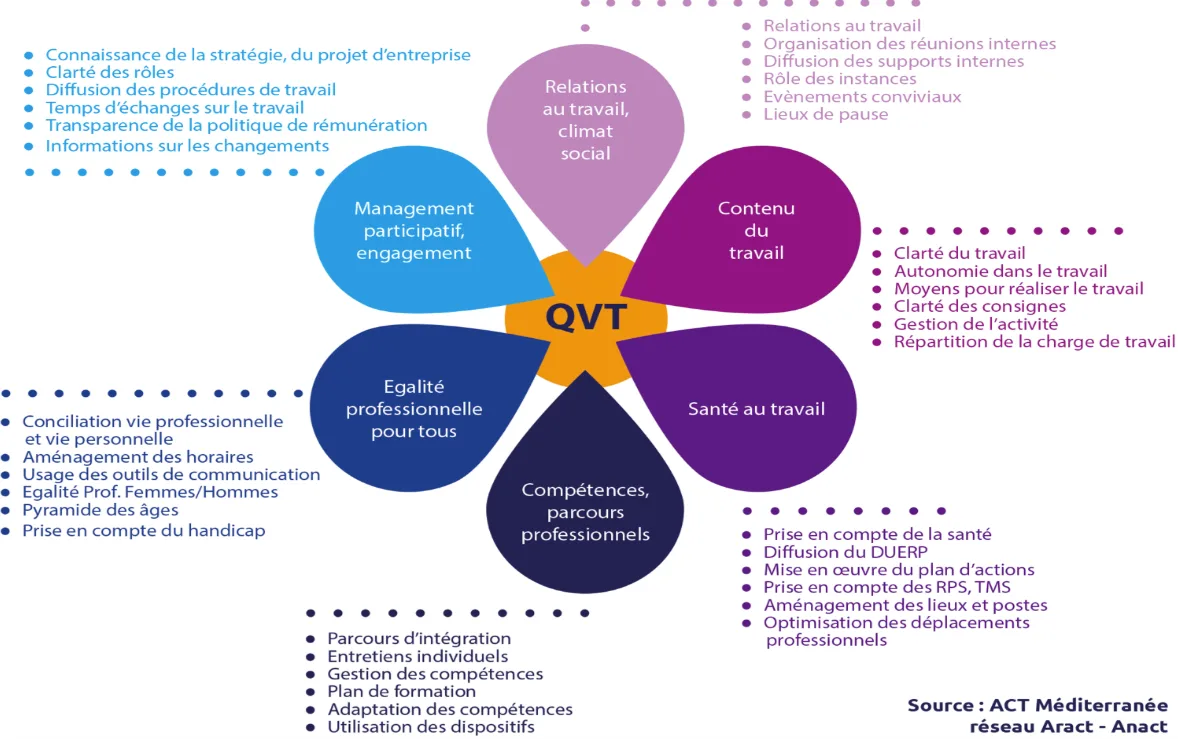
Assessing psychosocial risks is an opportunity to develop quality of life and working conditions (QVCT), which has been integrated into French social dialogue since 2013.
The QWL (Quality of Work Life) initiative aims to create an environment where employees feel useful, heard, and valued. It is based on several key areas:
- Social dialogue and participation : involve employees in decisions that concern them
- Acknowledgement : to highlight individual and collective successes
- Work organization balance between demand and available resources
- Work-life balance : flexibility and the right to disconnect
Inspiring example: an industrial company
A factory with 300 employees, facing high staff turnover, applied the Siegrist model. The diagnosis revealed a significant imbalance: substantial investments (shift work, production requirements) against limited recognition (few opportunities for advancement).
Actions implemented:
- Collective recognition system for objectives achieved
- Internal training programs that promote career advancement
- Opportunities for discussion between management and teams
Results obtained: The annual staff turnover rate has decreased from 18 % to 9 % in two years, also improving organizational attractiveness.
5. Conclusion – Take action now
The assessment and prevention of psychosocial risks lie at the intersection of several challenges: legal, human, and financial. They represent a long-term investment that fosters collective performance and competitiveness.
In summary:
- It is a legal obligation: every employer must include psychosocial risks in the DUERP (Single Document for Risk Assessment).
- It's a human issue: preserving the psychological health and well-being of employees
- This is an opportunity: to improve the quality of work life and retain talent
The first step is often the most difficult, but can prove to be simple: form a project group, administer an initial questionnaire (Karasek or Siegrist), analyze the results and initiate dialogue.
«"Assessing psychosocial risks is not just about avoiding distress: it's about building a more humane, more resilient, and more efficient organization."»