


Quality of Work Life (QWL) suffers from a persistent misunderstanding: many reduce it to "well-being" and place it in the category of pleasant but secondary topics, good for image or for "making people happy." In reality, QWL is a matter of performance in the most basic sense: the ability to produce consistently, maintain quality, reduce errors, prevent accidents, retain talent, and preserve engagement. A company can post excellent results one quarter and pay a very high price for organizational burnout over two years.
The key to linking QWL (Quality of Working Life) and economic performance is to change perspective.
Quality of Work Life (QWL) is not a collection of benefits. It is primarily an approach to reducing friction and risks associated with actual work. Organizations waste enormous amounts of energy on invisible mechanisms: malfunctioning tools, inconsistent procedures, constant interruptions, shifting priorities, pointless meetings, lack of maintenance, over-control, and unnecessary reporting. Each instance of friction consumes time, increases mental workload, creates errors, and degrades quality. And when pressure mounts, these frictions become multipliers of accidents, conflicts, and disengagement.
The first step, therefore, is to put figures on what we are losing.
No need for a sophisticated model: absenteeism, turnover, replacement costs, rework/non-quality, involuntary overtime, accidents (direct and especially indirect), IT malfunctions, time wasted on value-laden tasks. As soon as these data are examined within a specific scope, a simple fact emerges: a portion of the costs is not "the fault of the people," but the result of a poorly designed work system.
The second step involves choosing a few QWL (Quality of Working Life) levers with a quick economic impact.
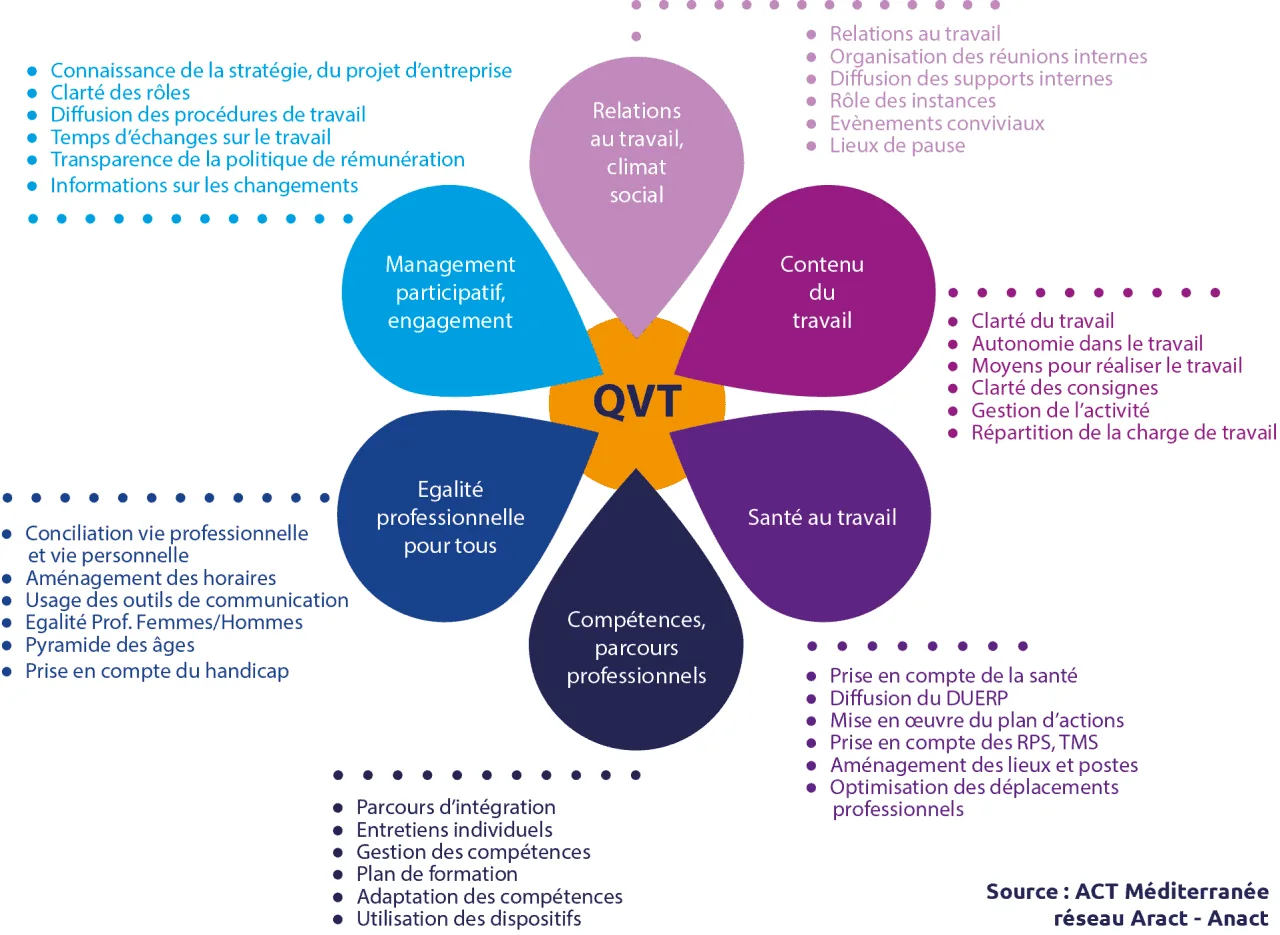
This is where many companies go wrong: they launch initiatives that are too general, too far removed from the realities on the ground, or too focused on culture, without changing the organization itself. The most effective levers are often quite mundane: clarifying and stabilizing priorities, regulating workload, improving the reliability of tools and interfaces, strengthening frontline management, eliminating irritants, and preventing musculoskeletal disorders (MSDs) and psychosocial risks (PSRs) where they actually occur. Nothing spectacular. But that's precisely what works.
A typical example: a team under pressure, living in a constant state of crisis. When a short weekly arbitration ritual is implemented—not just another meeting, but a real session where everyone clarifies what is being done, what isn't, what is being postponed, and with what resources—a decrease in errors, better planning, fewer "invisible" hours, and a healthier relationship between managers and teams is often observed. Quality of work life often begins with the right to say, "We can't do everything," and with managerial courage: "So we make choices.".
Another example: the hunt for irritants
Many organizations conduct QWL (Quality of Work Life) surveys that produce reports… and then nothing. Instead, it's often more effective to treat QWL as a continuous improvement process: a backlog of pain points, prioritized with input from the field, identified responsibilities, rapid corrective actions, and visible evidence that "things are happening." It's not glamorous, but it's precisely what rebuilds trust and performance.

The key to success, finally, is to manage QWL (Quality of Work Life) as a performance issue, not as a campaign.
This means: a sponsor, a pace, balanced indicators, and equipped managerial accountability. Managers cannot be expected to regulate workload, prevent psychosocial risks, detect early warning signs, and maintain performance… if they are not given practical training, decision-making power, or coherent objectives.
When QWL (Quality of Working Life) is approached in this way, the tension between "performance and working conditions" is transformed. It's no longer a question of a moral compromise, but rather an organizational adjustment: doing better with less wear and tear, fewer errors, and fewer hidden losses. And at that point, QWL ceases to be a cost; it becomes an investment in resilience.