


Most organizations begin their safety performance assessments with simple figures: frequency rate, severity rate, number of accidents. These indicators are useful, but they often come too late. They only show what has already happened. But managing is about preventing that from happening. The real challenge of HSE data, therefore, is to move from a "reaction" approach to a "control" approach.
The most realistic path is one of maturity. Initially, a good Excel spreadsheet might suffice. But it must be well-designed: stable definitions, comparable data, and above all, indicators that help with decision-making. Many spreadsheets fail because they confuse the quantity of information with the ability to act. Useful "management" answers specific questions: Where are our major risks? Where are we drifting? Which actions are lagging behind? Which exposure is increasing? Which site has a weak signal? If your spreadsheet doesn't answer these questions, it's not management, it's just archiving.
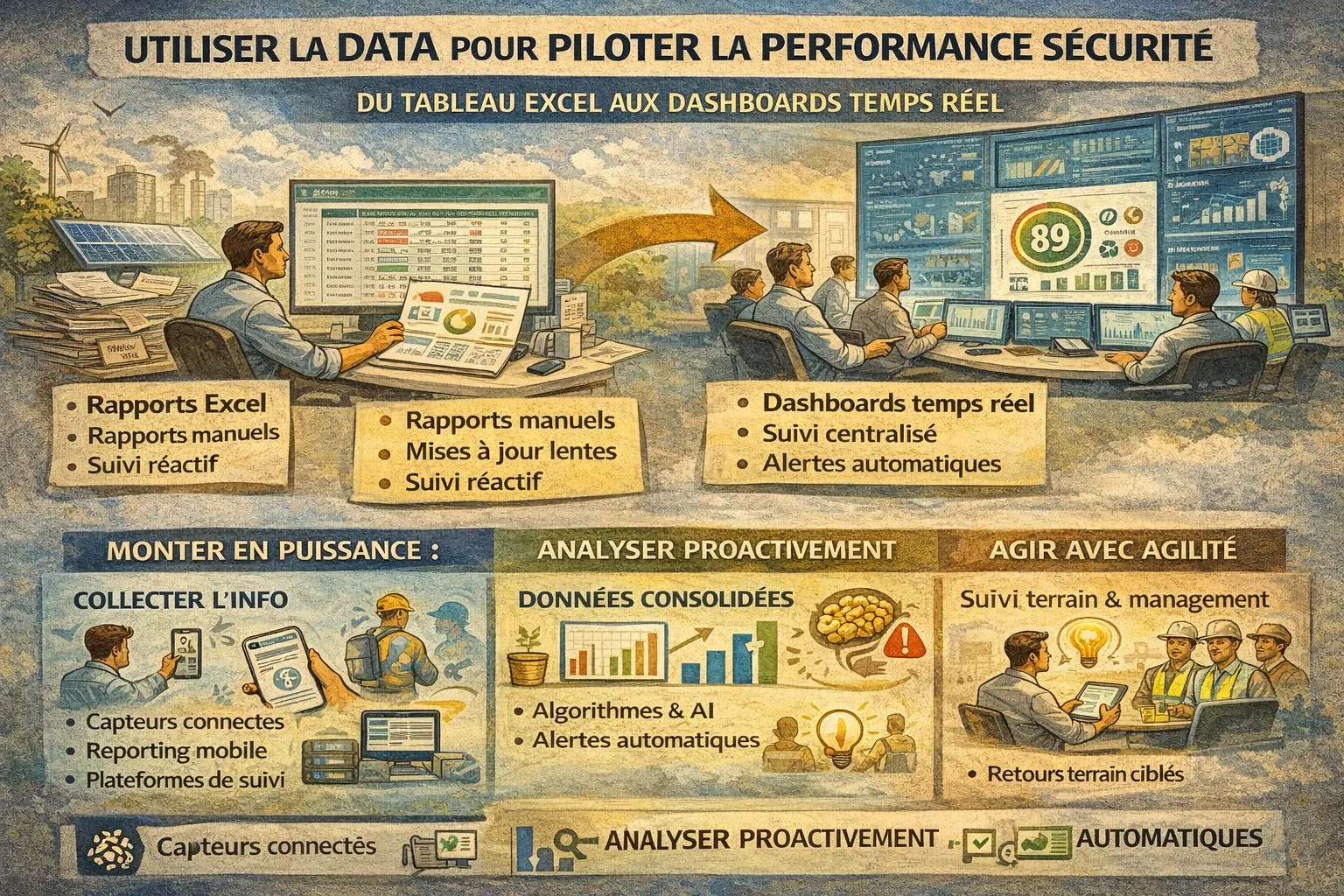
The first step forward is to balance the "lag" and "progress" indicators. Accidents and occupational illnesses remain essential, but it is also necessary to look at what precedes them: reports of dangerous situations, near misses, results of site visits, compliance of critical barriers (lockout/tagout, permits, checks), up-to-date training/qualifications, quality of incident analyses, and action processing times.
A company can have a beautiful dashboard but flawed data, and therefore make poor decisions with great confidence. Quality, in this context, is primarily a matter of definitions. What constitutes a "near miss"? What is a "safety inspection"? What is a "closed" action? As long as the various systems don't speak the same language, the dashboard is misleading. HSE data governance is a real project: definitions, data entry rules, consistency checks, training for contributors, and resolution of exceptions.
The shift to dashboards (or even real-time data) shouldn't be a technological obsession. It must be justified by a managerial benefit. For example, in subcontracting and concurrent activities, near real-time monitoring of authorizations, prevention plans, qualifications, and deviations can significantly reduce risk. Similarly, in multi-team environments, real-time monitoring of certain indicators (work permits, current lockouts/tagouts, concurrent activities) can prevent dangerous situations. In other areas, a well-maintained weekly review is sometimes far more effective than a continuous data stream.
The other key point is integration into routine. The dashboard shouldn't be just "a screen." It should fuel a structured discussion: what's going off track, why, what decision is being made, and how is its effectiveness verified? Mature organizations use data to make prevention a management discipline: less talk, more facts, and above all, more action.
Conclusion
HSE data is not valuable for its sophistication, but for its ability to support better decisions. Good safety management isn't about "seeing everything." It's about seeing early, seeing accurately, and quickly transforming information into action.