
Single risk assessment document (DUER/DUERP): how to turn it into a management tool rather than a forgotten file
- Marc Duvollet
- Mar 9
- 3 min read

In many companies, the DUERP exists… somewhere. A file, a folder tree, a version that is “up to date” on the day of an audit, and then radio silence. This scenario is common, and it does not mean that companies do not care. Rather, it points to one thing: the DUERP is too often treated as a compliance document, when it should be treated as a management system.
Let us first recall what it is: the DUERP formalizes the assessment of occupational risks and serves as the foundation for the prevention approach. It is not just about identifying hazards, but also about prioritizing and organizing preventive actions. And since recent regulatory developments, it must in particular take into account certain aspects of work organization, which further strengthens its natural link with quality of life and working conditions (QVCT).
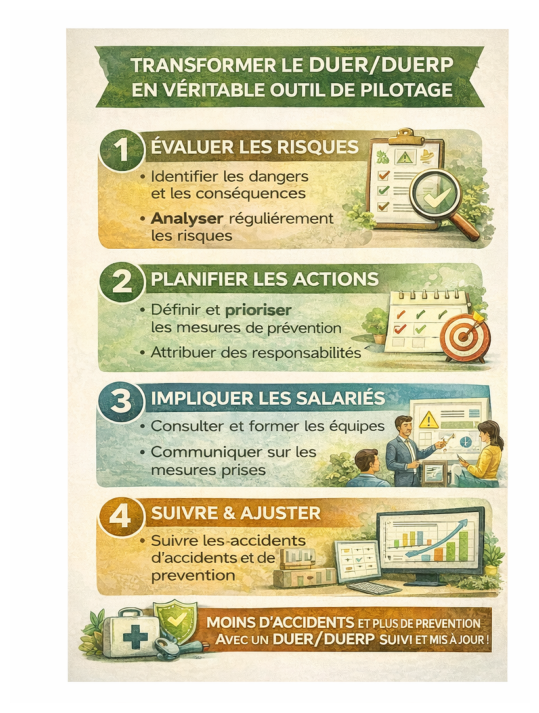
A DUERP that truly supports management is based on a simple idea: it must reflect real work. The first common pitfall is defining work units that are too abstract (“production,” “administration”) or too theoretical. By contrast, a useful DUERP breaks down the field in a practical way: a team, a workshop, a type of intervention, a round, a recurring activity. This is the level at which exposures can be observed, workarounds understood, interfaces identified, and appropriate control measures defined.
The second pitfall is making an inventory without prioritization. A DUERP that lists fifty “medium-level” risks ends up neutralizing prevention: everything seems equally important, so nothing moves forward. Prioritization is not a methodological detail; it is a management act. It forces the organization to say: what are our major risks? Which ones are frequent? Which ones have serious consequences? Which ones are deteriorating? And above all: where are we putting resources this year?
From that point on, the DUERP must produce what the regulations require: for some companies, an annual prevention program; for others, preventive actions proportionate to their size. But the difference between a “paper” DUERP and a DUERP used as a real tool comes down to one thing: the quality of the action plan. A useful action plan looks like a project plan: a person in charge, a realistic deadline, resources, a success criterion, and an explicit management decision when something is blocked. Otherwise, what you get is a list of good intentions—and that is, fundamentally, what many field teams criticize about the DUERP.
The third point, often overlooked, is rhythm. A DUERP is not “alive” because it is updated. It is alive because it is reviewed. This can be done very simply: a short monthly or bimonthly review linking events to actions. What happened (accidents, near misses, alerts, irritants)? What did we do? What do we decide? What do we postpone, and why? As soon as this ritual is established, the DUERP changes status: it becomes a risk dashboard, not just another file.
Finally, it should be remembered that the DUERP does not stand alone: it must circulate. In France, the employer must in particular send it to the occupational health and prevention service (SPST) after each update, which is an excellent lever for structuring discussion around risks and actions. From a legal standpoint, this requirement is clearly set out in the Labour Code.
When these elements are brought together—realistic breakdown, clear prioritization, managed action plan, regular review ritual, circulation, and evidence—the DUERP becomes what it should always have been: a simple way to connect the field to decision-making and to turn prevention into sustainable performance.


Comments