
Sensors, IoT, AI: which HSE–CSR innovations are mature and accessible for SMEs and mid-sized companies?
- Marc Duvollet
- Mar 5
- 2 min read

When IoT and AI are mentioned in HSE, many SMEs and mid-sized companies think: “this isn’t for us.” Too expensive, too complex, too risky. And yet, some innovations are now very accessible—provided they are approached pragmatically: start from a concrete problem, test quickly, measure the return, then roll out in a sober way.
The starting point is not the technology; it is the risk or the waste. On the environmental side, for example, sensors and meters can help reduce energy use and losses: electrical sub-metering, compressed-air monitoring (often a major source of waste), leak detection, temperature monitoring, ventilation optimization, or detecting abnormal consumption. The value is not only “CSR.” It is cost control and process stability.
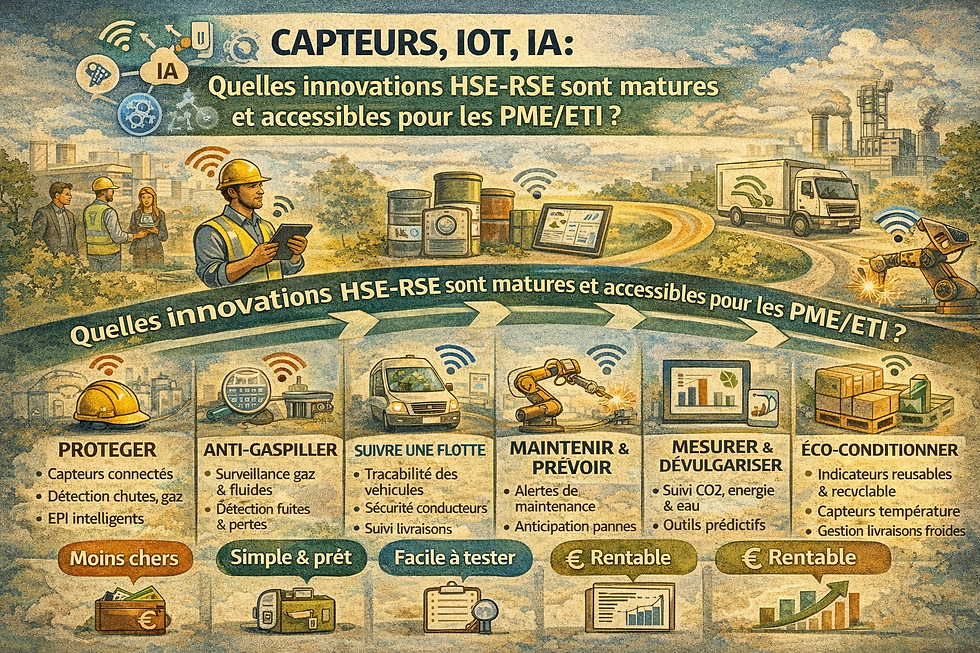
On health and safety, IoT is particularly useful when risk is tied to exposure or isolation. Lone-worker protection devices, gas detection, noise measurement, or monitoring certain ambient parameters (temperature, humidity) are fairly mature use cases. In some contexts, indoor geolocation solutions can help manage hazardous zones, but they immediately raise privacy questions: they are only acceptable if they are proportionate, transparent, and governed rigorously.
AI becomes interesting when it improves observation without creating a permanent policing system. A typical use case is image analysis to detect anomalies (cluttered areas, missing PPE in critical zones, intrusion into restricted areas) or to help spot weak signals. But here again, ethics and acceptability are central. If AI is perceived as a tool for individual surveillance, it can destroy trust and therefore harm safety culture. The most effective projects focus on major risks, anonymize as much as possible, and primarily aim to correct the work environment rather than punish.
For SMEs and mid-sized companies, the key is the deployment method. A good pilot starts small: one scope, one risk, one success indicator, and a short timeframe. Measure impact—including side effects: maintenance workload, reliability, false positives, time needed to handle alerts. A pilot is not a showroom. It is a value test.
Finally, never underestimate the associated risks: cybersecurity, vendor dependence, maintenance, data quality, GDPR compliance, and social acceptability. In many projects, the technology works… but the organization doesn’t follow: no one has time to process alerts, or no one dares to say the data isn’t reliable. A simple solution that is well governed is better than an “intelligent” system abandoned after three months.
Conclusion
IoT and AI are not reserved for large groups. Accessible innovations exist—provided you choose them for a specific use case, manage ethics and trust, and prove return on investment. In HSE–CSR, technology must remain a means; the end goal is always risk control and impact reduction.


Comments