
Dialogue social and CSR: making employee representatives partners in environmental transformation
- Marc Duvollet
- Mar 5
- 2 min read

On paper, environmental transformation is a matter of strategy. In reality, it plays out in how work is organized: new gestures, new constraints, new trade-offs. And as soon as work changes, social dialogue becomes either an accelerator… or a brake.
Many companies fall into a false dilemma: “if we involve people too early, we’ll get blocked” versus “if we decide alone, we’ll move faster.” In practice, those that succeed treat social dialogue as a co-construction mechanism: a clear framework, shared data, and defined room for manoeuvre.

The keystone in 2026: sharing structured environmental information
In companies with at least 50 employees, the employer must provide the works council (CSE) with an Economic, Social and Environmental Database (BDESE). And the environmental section is not decorative: it is regulated, in particular through the decree that specifies environmental indicators to be included in the BDESE (a “supplementary” list in the absence of an agreement).
In other words: if you want mature social dialogue on ecological transformation, start with data that is shared and understandable.
Moving from “consultation” to “co-production”
Employee representatives can bring three very concrete contributions:
On-the-ground reality: what truly works, what malfunctions, irritants, and risks.
Acceptability: what teams are ready to do (and under what conditions), and how to avoid passive resistance.
Fairness: distributing effort (schedules, constraints, multi-skilling) without creating a perceived injustice.
To capture these contributions, you need to move away from last-minute dialogue (when everything is already finalized). Ideally, set up a simple annual cycle aligned with your CSR steering.

A format that works well: “1 objective – 3 impacts – 5 decisions”
When you present an environmental project (source sorting, energy reduction, process change, procurement, etc.), structure the discussion around:
Objective: what you aim for and why
Impacts: on work, on safety/health, on jobs/skills
Decisions to be made: what is non-negotiable, what is open to arbitration, and what remains to be co-constructed
This format avoids the “catch-all” meeting and puts everyone at the right level: transformation is not a debate of opinions—it is a discussion about impacts and choices.
The HSE watch point: don’t “go green” by degrading working conditions
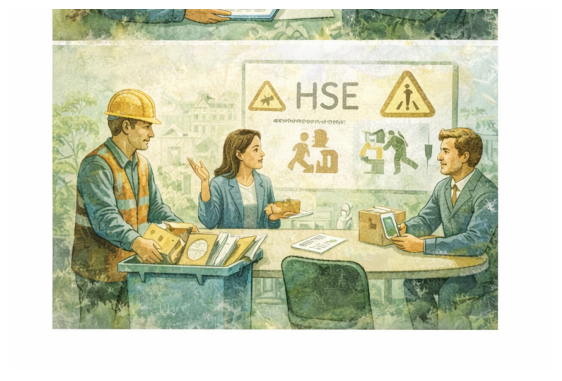
A classic pitfall: intensifying sorting, increasing reuse, changing work pace… and creating MSDs, overload, co-activity issues, or even incidents. The HSE angle is your safeguard: every environmental project should have a mini prevention plan attached (risks, measures, training, feedback).
Conclusion: social dialogue is not a checkbox—it’s a lever
In 2026, the question is no longer “should we involve employee representatives?” but “how do we involve them to gain in quality, safety, and speed of execution?” An imposed transformation may go through… but it comes at a high cost in tensions and disengagement. A co-steered transformation often progresses faster, because it holds up on the ground.


Comments