
Deploying a carbon emissions reduction strategy (Scopes 1, 2, and 3) at the scale of an SME or mid-sized company
- Marc Duvollet
- Mar 9
- 3 min read

Reducing greenhouse gas emissions is no longer an issue reserved for large listed corporations. More and more SMEs and mid-sized companies are being challenged—by customers, investors, employees, or directly by regulation—about their carbon footprint. Many still feel at a loss: how can they tackle such a complex topic with limited resources? What do the famous “Scopes 1, 2, and 3” actually mean for a mid-sized business? And above all, how can they move from measurement to action without jeopardizing their economic balance?
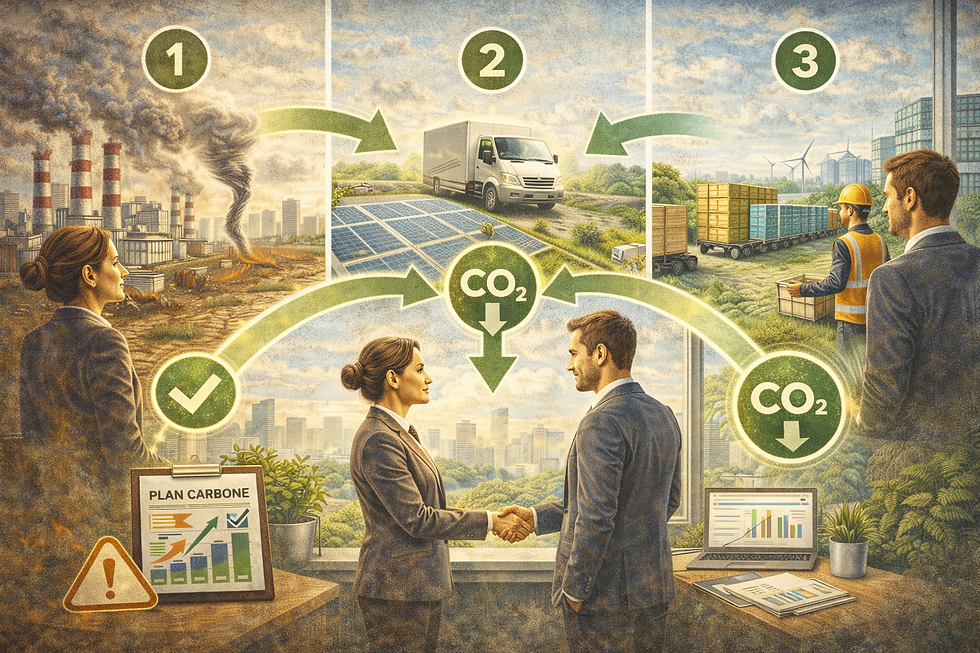
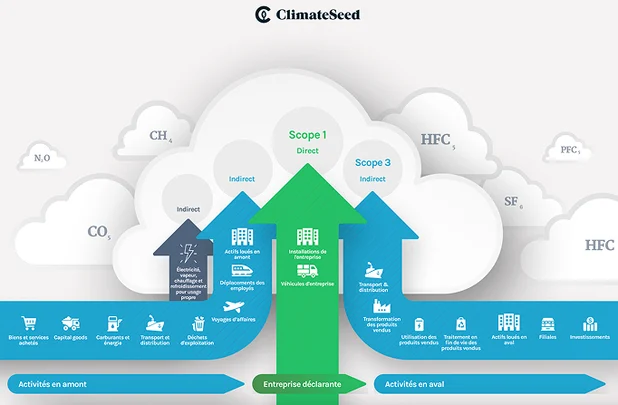
The first step is to understand what these scopes cover. Scope 1 includes the company’s direct emissions: combustion of fossil fuels on site (boilers, furnaces, combustion engines, etc.), fuel used by vehicles owned or controlled by the company, and certain industrial emissions. Scope 2 covers indirect emissions linked to purchased and consumed electricity, heat, or steam. Scope 3 includes all other indirect emissions: purchases of goods and services, upstream and downstream transportation, business travel, commuting, use and end-of-life of products sold, investments, and so on. For many companies, Scope 3 represents the largest share of their carbon footprint.
For an SME or a mid-sized company, it often makes sense to start with a simplified assessment, focusing on the most significant categories. Rather than aiming immediately for perfect completeness, the objective is to identify the main orders of magnitude: what share of our emissions comes from our sites (heating, processes), from our travel, from our purchases, from our logistics, from the use of our products by customers? Today, many tools, support programs, and sector-specific guides exist to help companies carry out this first diagnosis without mobilizing disproportionate resources.
Once this diagnosis is in place, it becomes easier to define priorities. If a company finds that most of its emissions come from gas consumption to heat its buildings, it may focus on insulation, controls, heating optimization, or gradually switching to other energy sources. If another discovers that business travel by car is a major source, it may work on its mobility policy: expanding videoconferencing, promoting rail, introducing a carpooling plan, or changing the vehicle fleet. If a third sees that its purchases of raw materials or subassemblies weigh heavily, it may engage with suppliers, rethink sourcing choices, or work on eco-design.
Setting clear objectives is an important step in giving the effort direction. These objectives must be both ambitious and realistic, taking into account technical, economic, and regulatory constraints. They can be expressed as percentage reductions compared with a reference year, over a five- to ten-year horizon. It is often useful to distinguish between internal objectives (what the company sets for itself) and external commitments communicated to customers or partners, while remaining very cautious about greenwashing risk.
Moving into action requires mobilizing all the company’s functions. Operations and production are naturally on the front line to improve energy efficiency, optimize processes, and reduce losses. Procurement plays a crucial role in integrating climate criteria into the selection of suppliers, materials, and logistics providers. Sales and marketing can work on lower-impact offers and on highlighting lower-emission solutions for customers. HR supports the development of skills and takes into account the social implications of change (evolving roles, training, potential redeployment).
Here, leaders act as the conductors. They must arbitrate investments, give meaning to the approach, define priorities, and sometimes accept longer payback periods in exchange for significant reductions in carbon footprint or vulnerability to fossil fuels. They must also remain vigilant about overall consistency: a company that communicates heavily about its “carbon neutrality” while continuing highly emissive and uncontrolled practices exposes itself to backlash.
For an SME or mid-sized company, external cooperation can be an accelerator. Participating in collective programs (by sector or territory), relying on professional networks, and pooling certain diagnoses or training efforts makes it possible to benefit from the experience of comparable companies, avoid reinventing the wheel, and share good practices. Some regions and sector ecosystems offer dedicated support schemes for companies’ climate transition.
Finally, the importance of involving employees in this effort should not be underestimated. Many already have strong awareness of climate issues and can be a source of proposals. Involving them in identifying levers, implementing certain actions, and monitoring progress strengthens the strategy’s roots in the company’s culture. It is also an attractiveness factor: an SME or mid-sized company that shows it takes these issues seriously—even without the resources of a large group—can stand out in the job market.
Deploying a carbon emissions reduction strategy at the scale of an SME or mid-sized company does not mean aiming for immediate perfection. It means accepting to move forward step by step, starting with the most significant emission sources, experimenting, correcting, and learning. Above all, it means recognizing that the climate transition is not only a constraint, but also an opportunity to rethink the business model, gain efficiency, and strengthen resilience.


Comments